April 2009
By Jaymi Curley
As belts tighten across the country and the green movement explodes, the local food movement is gaining 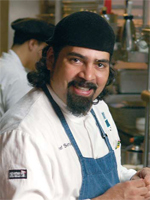 ground as a way to both save money and eat better. Consumers are turning toward this trend, and many chefs who have long espoused the philosophy of using fresh, seasonal and local ingredients have found their restaurants attracting a wider audience. But in the wake of the current economic downturn, it can be a delicate balancing act to keep both the customers and the bottom line healthy and well fed. Chef/owner Hector Santiago of the tapas restaurant Pura Vida is one of a collection of Atlanta chefs who are embracing this challenge, channeling a passion to change the way we eat into a thriving culinary concern.
Chef Santiago does use special ingredients imported from places like Peru and Argentina to support his diverse Latin American menu, but he is highly invested in using local goods for much of his work. “It’s really important to me to get local products,” he says, “because of the quality and the freshness of those products.”
While Georgia is a rich agricultural basket, Santiago does encounter some challenges in sourcing organic, locally grown product. “The biggest setback,” he says, “is that the network is not developed really well yet. It’s better now than a few years ago, of course. But that is the biggest problem, the jump from having the product in the farm and bringing it directly to the restaurant, to the chef.” However, Chef Santiago says the way to deal with it is to be on top of it. “I go to the farmer’s market, meet them, see what they grow, work out what they can maybe grow for me that fits my concept. You have to develop a relationship, with you helping the farmers, them helping you.”
 Joe Truex, chef/owner of Repast in Atlanta, has fully embraced this challenge, channeling his driving passion to change the way we eat into making his three-yearold business thrive, even in a recession.
“This is definitely a lifestyle choice,” says Chef Truex of his 89-seat fine dining establishment, situated in the heart of Midtown Atlanta, which he owns with his wife, Chef Mihoko Obunai. “This is a way for us to enjoy our lives and contribute to the well- being of others. We sell experiences here – food, wine, ambience, service. Sure, I could open up a 500-seat restaurant next to the Georgia Dome, and make a lot of money. But I want to make money on my own terms, doing what I care about, not just chasing the dollar.”
What Chef Truex cares about most is promoting a mindfulness about what we put into our bodies. Eating seasonally from what is grown locally, he maintains, is the way we are supposed to eat. “Visit Japan, Italy, rural France. Eating locally is a way of life; it’s what they know. It’s what your body understands and what everyone is trying to get back to.” Chef Truex thinks that in this country, “the way we eat is killing us,” and that the costs involved in transforming our diets would be more than made up with a reduction in health care costs.
Working with small-scale farms and growers presents some challenges for Repast’s owner. “One of the biggest difficulties is availability,” says Chef Truex. “Sometimes, small operations, they are just like small business, subject to more fluctuations than larger business. Also, you get your produce right out of the ground as it comes, trimmed or not, in varying sizes. Small farms are limited in their resources to prepare the meats with the cuts you want, too. You might get more uniformity when dealing with a larger processor.” However, the personal relationships he says he develops go a long way toward solving any problems. “What’s great about it is working with growers directly to give me my produce the way I want it, learning more about the product, about the people who grow it, the stories. I couldn’t do that with a large company. I wouldn’t even know who to call.”
Even once the product is in hand, Chef Santiago must still be vigilant about making the most of it. Buying local organic and seasonal goods can be more costly than the more traditional methods of procurement, and in the current economy, every penny counts. Chef Santiago keeps a careful eye on his produce and the bottom line at the same time. “Maintaining the fresh ingredients is all about taking care of them. Like our local tomatoes, for example. We buy local, we place them in a ripening area and check them daily to see which ones are going to get used today.” Chef Santiago also cleverly manages his food costs by employing some very old-fashioned thinking to his modern kitchen. “The way I work is, I cut my costs by making sure I am using everything, every possible part of my ingredients. I get, say, a whole trout; I don’t throw anything away but the guts. If it comes with roe, we use the roe for caviar. The bones we make into stock. We get the most out of the product by making sure nothing goes to waste.” Chef Santiago says he can save between 5% and 8% on his food costs just by conserving.
Despite the added costs of sourcing high quality meat and produce from small local farms, a move that Chef Truex estimates adds approximately 20% to his food budget over more traditional mass-produced goods, he resists the drastic lowering of prices that some restaurant owners have resorted to in this economy to keep customers coming back. “I can’t start just saying everything is 20% off. It dilutes my operating integrity. If I got this hangar steak on the menu for $18, and suddenly I am charging $14 for it, customers are thinking, ‘Well, you must have been overcharging me for it before.'” Chef Truex keeps his fan base loyal, he says, by concentrating on adding value. “I’m running a small plates promotion right now: five different small-plates for $5 each; also, a wine promotion, selling a list of good wines apart from the regular list. I might sell a $50 bottle of wine for $40. I’m going to take a little less money, but [my customer] gets to eat great and drink great. And I am going to sell more that way.”
“It’s tough on the pocket, that’s for sure. It’s more work, it’s more expensive, it’s more everything. But it’s all about social conscience,” says Chef Santiago. “You’re able to serve produce you’re proud of, that is not full of preservatives and hormones. After all, it’s what I eat every day, too.”



