By Christy Simo
 Despite all the challenges, many people in the restaurant industry still find a way to make time for causes they care about, whether it’s sustainable seafood, growing the craft brewery industry in Georgia, or supporting members of the restaurant community when a crisis comes calling.
For Dave Snyder, giving back has always been a part of his DNA.
“I’m big on community,” he says. “My parents really got me into that.”
Dave is the owner and chef of two restaurants on St. Simons Island, Halyard’s and Tramici. He also volunteers his time by sitting on the board of organizations as varied as Hospice of the Golden Isles, the Coastal Symphony of Georgia and The Boys and Girls Club of Southeast Georgia. He serves on the Culinary Board for College of Coastal Georgia and is an active supporter of numerous other organizations, including The St. Simons Land Trust, Cystic Fibrosis and The Humane Society of South Coastal Georgia.
But his biggest passion is sustainable fishing.
“I want to make sure that future generations and my kids have that same hobby and same joy that I do. And there’s only one way to do that, and that’s to make sure these species are around,” he says. “From a business standpoint, if I don’t have fish to sell, I probably won’t be in business very long.”
Overfishing has led to a number of species becoming threatened or extinct, and the price per pound of many species that were once considered standard fare in restaurants has gone up substantially.
Snyder works with the South Atlantic Fishermen’s Association and the South Atlantic Fishery Management Council to improve the sustainability and health of the waters along Georgia’s coast, the availability of local fish and the financial future and heritage of the fishing industry.
“The price of fish is going to continue to skyrocket. Fish has doubled in price from what it was only five years ago,” Snyder says. “It’s going to continue to skyrocket, so we just need to make sure we’re careful about how we maintain it.”
Snyder was recently named to the South Atlantic Fishery Management Council’s Snapper Grouper Committee.
“I’m excited because I’m the first restaurant owner or chef who has gotten onto the snapper/grouper advisory panel, so I’m bringing something different and hopefully informative to the panel,” he says. “What my job is going to be is to try and get alternative species more widely used. We’ve got to introduce new species. We’ve got to be able to figure something out. We’ve got to make it affordable for people, and we’ve got to make it available to people, and that’s a hard balance.”
For more on the South Atlantic Fishery Management Council, visit www.safmc.net.
Supporting Local Breweries
John Pinkerton began brewing beer long before he opened Savannah’s Moon River Brewpub in 1999 – one of the first in the state. But it’s only been in the past few years that the craft brew industry has really taken hold in Georgia. That’s when John and others in the beer community decided to form the Georgia Craft Brewers Guild.
“The mission of the guild is to promote and protect Georgia craft brewers,” says Pinkerton, who is president of the 501 (c)(6) organization. “We’ve seen great growth over the past year. In the first couple of years, we doubled our membership. When we started the guild I think we had maybe 10 or 12 founding members, and within a year we had 20 some members.”
Since the industry is relatively new in the state, having an organization to turn to and fellow brewers to talk with has helped tremendously for those looking to start their own brewery.
Today, there’s nearly 30 craft breweries in Georgia – more than double the number that existed when the Georgia Craft Brewers Guild (GCBG) was formed in 2010 – with many more in the process of obtaining licensing.
The guild works to raise awareness about craft breweries in the state, as well as supporting legislation that would help craft breweries thrive.
This past March, it held the first Georgia Craft Beer Fest to celebrate the state’s growing craft beer community. And in April, it hosted the first Southeastern Craft Brewers’ Symposium, a one-day conference with seminars from leaders in the craft brewing industry. Topics included how to raise funds and how to write a business plan for your startup brewery.
“If you want to sell what’s hot right now, you want to sell Georgia craft beer,” Pinkerton says. “With the guild and with the overall momentum of the industry across the country, Georgia craft is starting to become a recognizable class of its own. I want to make sure that every Georgia restaurant knows that there’s profits to be made by selling Georgia craft beer.”
For more information on the Georgia Craft Brewers Guild, become a member or support Georgia beer through a general donation, go to www.georgiacraftbrewersguild.org.
Giving Back
Restaurants and those in the hospitality industry are asked almost daily to help support various causes, but perhaps the most important cause is the restaurant industry itself.
In late 2012, Atlanta chef Ryan Hidinger was diagnosed with late-stage gallbladder cancer. Over the next year, members of the restaurant community rallied around him and his wife Jen to provide emotional and financial support. Ryan passed away in January, but out of his struggle, The Giving Kitchen was born.
“We provide crisis grants to those who work in the restaurant industry who are facing unanticipated hardship,” says Stephanie Harvey Galer, executive director of The Giving Kitchen. “So whether it’s an illness or injury, an unexpected fire or natural disaster, we provide cash grants to cover living expenses.”
The Atlanta restaurant community is a testing ground for this unique concept – nowhere else does this type of nonprofit organization exist.
“What’s different about The Giving Kitchen is that we’re serving an industry, not one company,” Galer says. “We’re able to leverage the whole industry to help the whole industry, which does make it a unique model.”
The Giving Kitchen modeled its process on corporate employee assistance programs, in which employees donate a portion of their paycheck to a fund to help anyone in need within the same company. But of course, those in the restaurant industry rarely work full-time for one company or restaurant, making it difficult to provide such support. Plus, working in the restaurant industry has its own set of perils.
“You may be exposed to more work hazards. You may slip. You’re working with knives. You may cut yourself; you may burn yourself,” Galer adds. “There are hazards that go along with that that then will also prevent you from working. “That’s what makes The Giving Kitchen so important” Hidinger says. “Of course it can help someone in a catastrophic circumstance, but it also helps somebody who faces a more minor diagnosis.”
“If you’re a server and you break your ankle, that’s very different than being someone who works in an office who breaks their ankle. You can’t work,” she adds. “The key is unanticipated hardship. It’s not just [for] illness and injury. If there’s a fire and you lose everything, or if there’s a death in your family … when there is an unanticipated crisis like that, there’s still need that isn’t going to be covered by any insurance.”
The Giving Kitchen has two types of grants: Crisis grants and matching grants. Both offer help to those who need it but are structured differently and have different criteria. Each requires employee verification to ensure that those requesting help are currently working in the restaurant industry.
Right now, The Giving Kitchen is focusing on full-service restaurants in the metro Atlanta area, but it plans to continue to expand its reach over time. It has just hired a new Director of Partnerships, Naomi Greene and it also has plans to launch an employee giving program.
“Anyone who works at a restaurant can set up a recurring donation to The Giving Kitchen so that everyone in the industry can give to support everyone else,” Galer says. “What we’re looking at now is a dollar per paycheck. If it’s a bi-weekly paycheck, it’s $26 a year, which is a bit of an industry standard among these employee assistance programs. That tiny donation can add up to a lot if you multiply it over all of the people who work in the restaurant industry.”
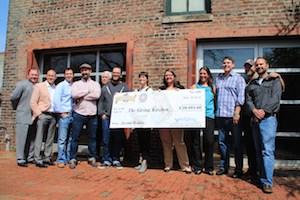
Many organizations in Georgia have already stepped up to help, including United Distributors and Sweetwater Brewing, which partnered with Ryan Hidinger in 2013 to create Second Helping. All proceeds from sales of the beer – more than $38,000 – went to The Giving Kitchen. And in April, 5 percent of sales on one day from all metro Atlanta Whole Food locations a total of $34,285 – were donated to The Giving Kitchen.
This fall, Staplehouse, the restaurant Ryan and Jen Hidinger had been working toward for years before he passed away, will finally come to fruition, opening in the Old Fourth Ward neighborhood of Atlanta. Chef Ryan Smith, formerly of Empire State South and brother-in-law to Ryan and Jen, will helm the kitchen. All proceeds from the highly anticipated restaurant will go toward The Giving Kitchen’s mission.
“If you can’t work, then you lose your job. And if you lose your job, then you lose your car, and you can’t get work anywhere, then you’re going to lose your house,” Galer says. “That kind of steamroll effect we want to try to stop as early as we can.”



