By Nancy Wood
As if the restaurant industry needed one more challenge, right? Yes, everyone is thrilled that Covid-19 restrictions are being lifted. People are getting vaccinated and feeling safer in public. And the months of limited dine-in seating and winter weather are behind us.
But as the hospitality industry gears up for full service once again, the next roadblock feels more like a brick wall: the labor shortage.
Finding and retaining reliable staff has always been a topic of conversation in the restaurant world, but the post-pandemic labor market is particularly challenging. While no one factor plays a role, most owners and operators have some pretty good ideas.
Some staff still don’t feel safe, furloughs took a toll and employees opted to go into other careers. There’s little if any affordable child care while some kids are still being home-schooled, and – perhaps the biggest reason – extended unemployment benefits mean some workers can make more money sitting at home.
Georgia restaurateurs are taking a good hard look at their operations, including their compensation models and their culture, to attract and retain employees. Lessons learned during the pandemic combined with a fresh perspective on what works – and what doesn’t – are providing the building blocks for solutions to the shortage.
Changing Compensation Strategies
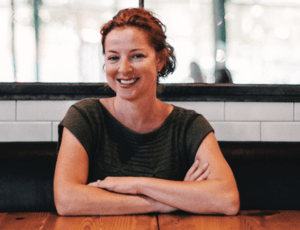 Jennifer Johnson, partner in Atlanta-based Rye Restaurants. Photo by Jason Travis
“I’ve always felt when times are leaner, you have an opportunity to step back,” says Jennifer Johnson, a partner in Rye Restaurants, which includes The General Muir, Wood’s Chapel BBQ, West Egg, Fred’s Meat and Bread, Yalla! and TGM Bread. “While we feel like, in some respects, we’re turning a corner,” she says, “there’s something new every day – and finding and retaining talent is at the top of that list.”
On average, the pay disparity between front-of-house and back-of-house positions is about 30% when you add in tips. And according to the U.S. Bureau of Labor Statistics, 80% of the lowest-paid occupations in Georgia are associated with full-service and limited-service restaurants. But many in the hospitality see the pandemic and all that it’s wrought as an opportunity to make positive changes for the future.
Johnson, an advocate of the $15 minimum wage, says the distinction between back-of-house and front-of-house pay inequities “has been a long time coming in this industry. If you’re running a business that cannot afford to pay a living wage,” she says, “you’re not running a business that should be around.”
During the pandemic, Johnson and her partners decided to reconfigure their compensation model at their dine-in locations, “because it’s not a good time to be a tipped server when the bulk of your business is to-go.” By instituting a 20% service charge, there are no gratuities. At the end of each shift, the service charge is divided up among every non-management employee.
“We are taking every restaurant one at a time,” she adds, “so we are not yet able to say that every single employee at every restaurant makes $15 an hour, but we are so close.” They have reached the mark at West Egg. “We now print it at the bottom of the menu so guests can read it, because,” as she says, “guests are often your next employee.”
 Joey Ward, chef/owner of Southern Belle and Georgia Boy
For Joey Ward, chef/owner of Southern Belle and Georgia Boy, in Atlanta’s Poncey-Highland neighborhood, the road to a new compensation model started before the pandemic. “Even before Covid, we were trying to change the system a bit,” he says, “and now coming out of the year 2020, we are going full speed ahead with trying to change the paradigm and shift that old-guard way restaurants are managed and the way people are compensated.”
Ward began by analyzing what was wrong with the system. “I was working people to death pre-Covid. Everybody wanted to be there but they were all burning out, so I wanted to go to fewer days a week and get a bigger bang for the buck.”
Now, after a pandemic roller coaster ride of closing, opening with to-go menu options, à la carte dining on the patio, take-out meals to finish at home, pop-ups and private parties – then closing in January 2021 and re-opening again in April – Ward has settled on a four- or seven-course tasting menu and a take-and-finish meal that changes every week.
His All for One model was helped by the fact that Georgia relaxed their laws regarding tip sharing as a result of the pandemic. “In order to have everyone in the pool,” he explains, “we had to pay everyone equally.”
Ward discovered that if everyone worked the same amount of hours, it helped alleviate the front-of-house/back-of-house pay disparity.
“Previously,” he says, “the cooks were working 60 hours a week and making $40,000 a year, and the servers were working a fraction of that and making twice as much.” Ward’s latest analysis puts his tip average at 26%, which means every employee is averaging $24 an hour.
The private chef’s table space, Georgia Boy, is still closed, but Southern Belle is now open Thursday-Saturday at night and a half-day on Wednesdays for prep only. “I think it’s important to look at trying to even out the amount of hours worked,” he adds, “and also trying to have everyone invested in the success of the business. If we’re busier, they’re getting more tips and being rewarded for that.”
Business Models
For business models that don’t rely on tips, there are other strategies to consider to attract and retain talent. Like Ward, Nate Hybl’s approach to the restaurant business started long before the pandemic.
Hybl is the creator of gusto!, which offers healthy fast food at seven locations in the Atlanta area with two more on the way. After a career as a college and NFL quarterback, he spent several years learning the business before launching gusto! and saw firsthand the critical role the right business model and brand culture play in recruitment and retention.
 Nate Hybl, founder of gusto!
“Finding talent and hiring is – and forever will be – a challenge,” he says. “The restaurant business has a lot of romanticism. It’s fun and high energy, but the dysfunction that I witnessed and the lack of respect and communication motivated me to build a meaningful brand and not just open restaurants.”
Hybl’s solution was to create a business model based on a bottom-up approach with an emphasis on communicating with each team member.
“We position our corporate team – our base team – at the bottom of the pyramid,” he explains. “Our job is not over the top as warlords looking down, but to support our leaders and to serve and support their teammates.”
Hybl believes his approach to operating a quick-service model differently also includes creating a culture that resonates with his younger employee demographic. “I think having a bright brand that feels young and fresh with good energy and warmth – those are feathers in our cap in terms of attracting somebody,” he says.
“We’re a purpose-driven company, and our job as an employer is to intentionally foster growth,” he adds. After hearing the word ‘growth’ in almost every single interview he’s conducted in the last few years, Hybl embraced it and says, “I think that’s the main reason we are able to attract employees, even when circumstances are elevated and more difficult.”
The company ‘walks the talk’ with a number of programs and tools that allow team members to grow as much as they want. Even the HR department is called the Team Member Experience Department (TMX).
“That means from the very first interaction a potential candidate has with our brand all the way to an exit interview,” he says, “we have our eyes on the team members personally and professionally.”
For example, the company doesn’t offer reviews – they have HEARD sessions. “Once a quarter, leaders sit down with every single team member and have a two-way conversation about what we’re doing right and what we’re doing wrong,” he says.
“It’s not just about compensation and what’s next, but we use it to try to get better and happily receive critical feedback because we want to be the best.”
Employees also have access to English and Spanish lessons as well as a multitude of books and programs. And in a special twist on bonding, Hybl has created a program of team outings – including rappelling and cliff diving. “I sum it up as interactive relationship building,” he says.
At each location, gusto! has a local operating partner who has a financial partnership with the brand. “They have what we call ‘freedom with a framework’,” says Hybl, “with freedom to run a program within our brand standards.”
The local operating partners are still employees of gusto!, but they do participate in profit sharing and are treated as business partners.
“Financially, we’ve architected a win-win relationship. We empower them to be an extension of our brand in the community,” he says, “and we put their name on the front door and it’s their shop.”
The Value of Retention
Rye Restaurants’ Jennifer Johnson admits her team is “going nuts trying to find talent” – reading thousands of resumes and scheduling interviews that end up with no-shows. One of her strategies is to focus on what’s often overlooked – retention.
“There are real costs in turnover and training,” she says. Taking a page from her previous career as an attorney, Johnson instituted a retention bonus for her employees. While the industries are totally different, the theory is the same – reward people for staying a certain length of time.
“So many of our people have been with us through the whole pandemic – even long before that,” she says. “We know them, we trust them and we care about them, and they stuck it out with us.”
Her thought is, “if we have to run so lean, let’s run lean with these people.” As a result, she increased the retention bonus during the pandemic. “We realize the most important people are those we already have,” she says.
Loyal staff also bring something else to the table: referrals. Like almost every restaurant, referrals from current employees are another way to find talent, so Johnson also offers small referral bonuses. “[Our employees] want to work with good people,” she says, “and they don’t want to suggest someone come work for us who they don’t want to work with – they don’t want to look bad.” For larger operations that have a lot of positions to fill, many owners use resources like Indeed and talent search firms to find candidates for high-level management positions.
For much smaller operations like Southern Belle, Ward says he has the most success hiring through referrals from friends and colleagues as well. “The people who work for us recommend people, and we generally get the best results from that,” he says. Ward has tried other platforms without much luck, so he also posts job openings on social media and with the Giving Kitchen, a non-profit devoted to helping food service workers.
Hybl also uses word-of-mouth, referrals and third-party services, and frequently features team members on social media. “That works as a natural recruiting tool,” he says. “I’m hoping to paint a picture of who we are as a company, diverse and welcoming. “We’re proud of our teammates – but they also serve as ‘do you want to come be a part of something different?’”
Looking Forward
As restaurateurs search to fill open positions, optimism in the industry still rules the day. While Jennifer Johnson says it’s an industry crisis right now, “I don’t think it’s a dire situation forever. Just as guests will start returning, the employees will as well.”
Admittedly, it may be hard to hire up to pre-pandemic levels, but Johnson says that may not be necessary. “Working leaner and smarter with the people you have – and they’re making more money as a result – may be the new normal. As long as you don’t overwork people and [you] create a place where they feel at home, taken care of and happy.”
Ward agrees. For him, finding and retaining talent depends on making sure the people that work for you feel like you care about them. “I’m not under any sort of illusion that I could do what we do on my own – without every single member of my staff participating and contributing. I let them know that,” he says, “and I try to show them by not only being there with them and encouraging them, but looking out for them. It’s more like a family at my place. and I think it starts at the top. You’ve got to treat everyone like you want them there and you’re grateful to have them.”
While Nate Hybl says “the onus is still on us as operators to attract and find and train and grow people who are willing, I still think that strong brands are going to attract strong talent.”
Although the labor pool is shrinking and some companies may embrace technology to replace human beings, he believes “people are forever going to be looking for work because it’s one of the things that fulfill us.
“I still believe in hospitality,” he says, “and I still believe that people want to work and feel fulfilled serving others. The human experience is going to come back – I believe that.”



