From Restaurant INFORMER, 2014, Vol. 4, Issue 1
By Helen K. Kelley
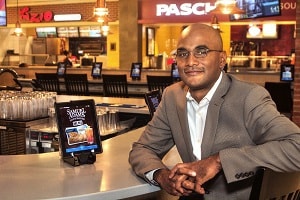 Anthony Joseph, president, Concessions International
With an increasingly mobile population, smaller and more portable technology and the proliferation of social media, restaurants today are focusing on new ways to provide convenience and create interaction with their customers.
Convenience and Comfort
Concessions International, LLC recently installed iPad digital menus at two of its locations within Hartsfield-Jackson Atlanta International Airport. The eTouchMenu interactive technology is available at Dos Equis Explorers Lounge and Samuel Adams Atlanta Brew House, the first restaurants at the airport to offer tabletop tablet ordering. At Dos Equis, there is a secured iPad available at every seat in the bar, and Samuel Adams offers the iPad at every bar seat and at seating along the bar area.
The menus, which are interactive and intuitive, were custom-designed by Menu Masters. Guests browse through the selections and enter their orders right at their own seat or table. The waitstaff is alerted to ordering activity and requests for service through a wireless paging service.
Anthony Joseph, president of Concessions International, says the technology offers many benefits, including the ability to show the restaurant’s entire menu.
“On a print menu, you can’t possibly display everything you offer,” he says. “But on a digital menu, we’re able to show the customer every item, accompanied by a great photo. It also gives us the capability to show brand and nutritional information.”
When time is of the essence, the digital menu offers customers a faster, more efficient way to order their beverages and food. They simply enter their selections by touching the screen.
Dos Equis Explorers Lounge allows customers to not only order, but also pay for their food and drink through the iPad menu – a big plus for air travelers who are often in a hurry.
“On average, the bill-paying process involves about three visits by the server to the table – delivering the bill, collecting the customer’s payment and then providing change or receipt. In an environment that is high volume and very busy, paying the bill can take up precious minutes for people who are rushed and anxious to move on,” says Joseph. “The option to pay through the tabletop menu gives customers the convenience of immediate payment, along with the security of having control of their credit card at all times.”
Basil Banko, vice president of information technology for Concessions International, says that the interactive menus have been successful so far, but adds that there have been a few challenges.
“Most business travelers really like the convenience of the digital menu – they can place their orders without waiting, enjoy their food and beverages, and get on their way promptly,” he explains. “But we’ve found that some older travelers haven’t embraced it, probably because it’s new. So we offer a print menu to those who don’t want to use the iPad. And it’s the same with servers – some love the iPad and some would prefer to give customers a regular menu. That’s just human nature. But the majority of customers and employees seem pleased with the technology.”
The digital menu has increased some efficiencies for both the Dos Equis and Samuel Adams locations, especially in getting orders to the kitchen. Banko adds that Dos Equis is experiencing the benefit of customers having the option to pay by credit card through the tabletop tablet.
“Travelers want to get in and out quickly, and the tablet gives them the ability to do just that by paying immediately,” he explains. “After observing the customers’ reactions at Dos Equis, we’ve decided to implement the payment option at Samuel Adams, too.”
David Shaw, CEO of Postec, Inc., a company that provides customized point of sale (POS) technology, says that an integrated system works best in locations that have high volume and need to provide fast service – such as airports and fast casual dining establishments.
“With the tablet, the consumer is actually serving as the order entry person – self-service. This process speeds up service delivery time and allows the POS system to do the ‘heavy lifting’ of kitchen output as well as report sales activity,” he says, adding that this type of technology is steadily growing in popularity. “The adoption rate is increasing as the number of tablet users grows along with their knowledge of how to use a touchpad. It’s much like the implementation of automatic teller machines at banks or the pay-at-the-pump option at gas stations.”
Interactive Purchasing Trends
Charles Marvil, corporate operations manager for Bhojanic Restaurant Group, is conducting research on information technology (IT) purchasing decisions made by restaurants as part of his requirements for a Master’s degree in HRMT (Hotel, Restaurant Management and Tourism) from Auburn University. The study focuses on the decisions to purchase or delay purchase of technologies by small-to-medium sized restaurant companies in Georgia.
“Based on an analysis of current trends, including a yearly survey conducted by Hospitality Technology magazine, my hypothesis is that the economy kept IT purchases down in the past couple of years. Restaurants were a little skittish about investing capital in a new system or upgrades when their current system wasn’t broken or they didn’t truly need it,” Marvil explains. “Now that the economy is on the upswing, restaurateurs are starting to reconsider those purchases and moving forward with them. And most people feel safe looking at hardware and software that will upgrade their POS systems and/or allow them to interact with their customers.”
Marvil’s survey asks participants to name the pieces of technology they feel are most critical to purchase for their operations, and he will collect data about secondary and tertiary purchases as well. So far, the emphasis seems to be on purchasing interactive software that allows the restaurant to push out information – such as special deals or new menu items – to the customer via email, text or social media or allows the customer to directly place an order.
“Being able to send out information to the customer’s smartphone is an immediate marketing tool,” states Marvil. “It’s a faster, more personal interface between restaurant and customer.”



