By Lara Creasy
From Volume 4, Issue 6
Craft is the buzzword in the beverage world these days. It has been for years. Craft beer has managed to rebound from an all-time low in the 1980s to its current double-digit annual growth rate.
Craft distilling is also on the rise. A decade ago, there were around 40 craft distilleries in the U.S. Today there are more than 400.
But a proliferation of products doesn’t mean things are always easy for restaurateurs who dedicate themselves to supporting craft beers, small batch spirits and limited production wines. There is often a good deal of work to be done to keep the bar stocked and the drinks flowing.
Securing Customer Buy-in
 The first step for many restaurateurs is gaining guest confidence in the unfamiliar products.
“Initially I had a lot of people who didn’t understand what I was trying to do,” says Bill Brown, proprietor of There Brookhaven, an in-town Atlanta gastropub with many suburban customers.
Guests were initially hesitant to step outside of their comfort zones and order unfamiliar products. Price was an early objection, says Brown, with people thinking all craft beers were high gravity and cost $7 a bottle.
“But we have been able to open the eyes of a lot of people,” he adds, pointing out that he has turned numerous Budweiser drinkers that enter his establishment on to Sessions, a lager made by Full Sail Brewing in Oregon. Full Sail swept the 2014 World Beer Championships with nine Gold Medals, yet There Brookhaven is able to sell Sessions for $3 a bottle, roughly the same price that consumers are accustomed to paying for Budweiser.
Staying Flexible
Another challenge bars face with craft products is out-of-stock issues, since many small producers are not equipped to keep up with high demand.
“It arises occasionally,” Brown says of stock issues, “but from my point of view, it doesn’t happen as much as it could.” Brown has six draft handles at There, and he dedicates all of them to very small, local breweries. “There are probably at least a dozen microbreweries within 60 miles of my establishment,” he says, adding that if one beer he’s been pouring goes out of stock, there are many more that he can choose from.
Being nimble enough to make frequent menu changes helps when working with craft beverages.
Brown uses a paper menu at There, but also relies on the creative talents of his kitchen staff. “One of them is incredibly talented in hand-lettering. He does the chalkboard. Sometimes it changes daily,” says Brown.
Social media can be a powerful tool in getting the word out about frequent menu updates. Brown says he has managed to get the “right people” in Atlanta’s beer world, such as blogger Ale Sharpton, to follow him on Twitter, so when new beers are available, beer lovers hear about it.
Business to Business
Brown says he views his support of small breweries as more of a win-win situation than a challenge.
“A large part of promoting the local breweries is getting out and meeting these guys. There is a struggle in running a small business,” he says. “I try to stay in contact with these guys, because I am not a big chain, so I understand. If I invest in a case of beer, I need to make sure it’s going to fit my clientele.”
Once Brown agrees to carry their beers, the brewers stop in and bring their friends. “They get bragging rights to have their beer on tap,” he says. “Then I get to talk to them and learn about how they make the beers.”
Brown even says that the guys from Pontoon Brewery, a current favorite of his, have met people in his bar that became influential to their success. “I introduced them to a commercial Realtor who helped them figure out what it would take to build their brewery,” says Brown. This real estate agent had already helped build several breweries in the area and heard that they were scouting locations in Brookhaven. Within two years, their brewery should be up and running, says Brown.
Distributors are also allies for bars dedicated to craft products, once they understand the restaurant concept.
Brown’s sales reps at Eagle Rock Distributing and Georgia Crown Distributing bring him growlers of special beers before release, he says, to gauge his interest in working with the beers and give him a chance to pre-order. “When limited beers hit the market, I may be able to get only one keg or one case,” he says, “but I am able to get the allocation.”
Real Vs. Fake Craft
Developing a personal relationship with the distributors and producers of craft spirits is important to Paul Calvert of Decatur’s Paper Plane as well. He worked closely with Quality Wine & Spirits several years ago to make sure a line of mezcals he wanted got registered in the state. But often, he says, distributors bring products in that require research on his part.
“As a buyer, the challenge has been trying to sort through the fake craft vs. the real craft,” he says. Large spirits companies are trying to make a footprint in the craft cocktail world, he says, and unless you are really informed, it’s hard to know which products are truly artisanal and which ones are made by a big company like Bacardi.
Even more confusing are the small distilleries that buy distillate from a mass producer, and then finish it locally. Calvert gives the proliferation of distilleries in Brooklyn as an example. “They buy bulk distillate from a producer in the Midwest, then run it through a gin head and put their own label on it. Is that local? Is that small batch? I don’t know.”
Buying regionally can help in this regard. “I’m more excited about people in the region doing stuff, so I can go meet them and talk to them. Even if they are making mistakes,” says Calvert.
All distilleries have to start somewhere, he says. Old 4th Distillery on Edgewood Ave. in Atlanta is an example. Like most startup distilleries, they only make vodka at this point, but Calvert says, “Support them now, and their next product might be a really delicious gin.”
Skipping the Middleman
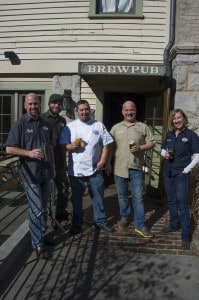 Taking local to another level is the brewpub, an establishment that brews and sells its own beer for on-premise consumption. Businesses like Wrecking Bar Brewpub in Little Five Points avoid many of the challenges Brown mentions by selling their own housemade product.
Stevenson Rosslow, managing partner of Wrecking Bar, says that unlike other establishments that offer only craft beers, pricing has never been an obstacle at his bar. When the beer is brewed and sold in house, the distributor tier is skipped over, so the beverage cost to the pub is very low, and they “pass the savings along.”
“I am able to operate at a very strong beer cost, under 25 percent, and still give the consumer a great price. We make it up in volume,” he says, citing a recent Saturday when his 100-seat pub did 840 covers. “That’s what we wanted to do from day one.”
Product recognition is not a fight Wrecking Bar has to win either, as most guests know coming in that they are getting housemade beers. “I have a guest tap on almost all the time,” says Rosslow. “But those beers don’t really move here, which is kind of an ego thing for us. Our beers just show really well next to the others.”
A Changing Landscape
Wrecking Bar is able to keep up with its own high in-house demand and is also able to brew enough beer to sell to others. A Georgia law change in 2012 increased the amount of beer brewpubs are allowed to sell off-premise from 500 barrels per years to 5,000 barrels per year.
Rosslow says Wrecking Bar invested in two new 30-barrel tanks in 2012 and since then has sold its beer to clients as diverse as Delta Air Lines, Brick Store Pub in Decatur and the Cloister at Sea Island. “As a result, the restaurant got busier, too,” he adds.
But selling their beer to others presents them with another set of state laws to work with. Wrecking Bar has to use a distributor to sell its beer, just like every other brewery. As a result, the profit margin they see per keg from an off-premise sale is not as high as it is when they sell in their own pub.
There is also a maddening law, hopefully changing this year, says Rosslow, which prohibits Wrecking Bar and other brewpubs from selling growlers to guests to take home. They can sell kegs to growler accounts, bars and restaurants through their distributor, and those accounts can sell growlers to consumers, but state law currently prohibits Wrecking Bar from filling growlers themselves, not does it allow breweries to sell beer on-site directly to consumers, whether that means a glass of beer or a six-pack. Georgia, it seems, is one of the few states left in the country that does not allow on-premise sales in some form for its brewpubs and breweries.
“This is something we are hoping that the GRA can help us with,” says Rosslow, mentioning that lobbyists at the capital can make a big difference in getting this law changed.
In fact, a bill has been introduced by Sen. Hunter Hill (R-Smyrna) in the 2015 legislative session that could change the face of Georgia’s brewing industry. Senate Bill 63, known as the Beer Jobs Bill, would allow for brewpubs like Wrecking Bar and breweries to sell limited quantities of beer on-premise for off-premise consumption.
As written now, the proposed law would allow brewpubs and breweries to sell up to 144 ounces of beer per individual per day – i.e., two growlers or the equivalent of a 12-pack – for off-premise consumption, and for breweries to also be able to sell 72 ounces of beer (the equivalent of half a dozen 12-ounce pours) on-premises.
At presstime, the bill still needed to be assigned to a committee for review before being voted on, but it has been gaining bipartisan support.
Current laws aside, Wrecking Bar and its brewmaster, Neal Engleman, have managed to gain acclaim for its beers, with three of them making Beer Advocate’s list of the Top 50 beers in Georgia. The brewpub even took the No. 1 spot with their Mexican Imperial Stout, which they only serve once a month. The 12.5 percent stout is aged for six months to a year with chipotle and Serrano peppers, Mexican cinnamon, cocoa nibs and vanilla beans. The pub taps a keg on the 5th of every month at 7 p.m., and it sells out in under an hour.
Quality All Around
Like Calvert, both Brown and Rosslow say that supporting craft distillers is a part of the work they do. Brown mentions Southern Son out of Texas as a current favorite. Rosslow says he has also long been a champion of craft spirit producers such as St. George, Ransom and High West.
He adds that buying good, small production wines is also something Wrecking Bar believes in.
“You walk into your average brewpub, and the wine list sucks. You are lucky if the bottle was even open today,” he says.
Because Wrecking Bar makes its own beer, and even its own mustard and hot sauce, their dedication to craft comes full circle to the wine list. “Everything we buy is going to be quality.”
Lara Creasy is a consultant with more than 14 years experience in beverage management. She has developed wine and cocktail programs for such restaurants as St. Cecilia and King + Duke through her consulting business Four 28, LLC. Her work has been featured in such publications as Bon Appetit, Imbibe, and Wine Enthusiast.



