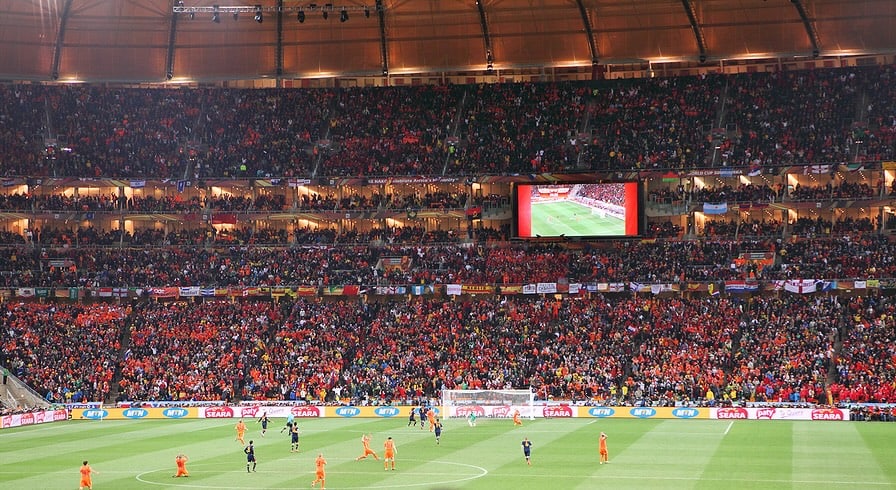
 This summer, Atlanta welcomes the 2026 FIFA World Cup as one of several U.S. host cities. We’ll see a total of eight matches from June 15 through to a semi-final game on July 15. There’s no doubt that the World Cup is a big deal, but as a non-soccer fan, I struggled to understand just how massive the World Cup is. Here’s a quick exercise that helped me put the magnitude of this event in context.
I looked at a broadcasting metric called “Total Audience Reach” that represents the number of people who watched at least 1 minute of a given telecast. The recent Oscars ceremony saw 17.9 million in total audience. Remember Game of Thrones? The last season’s finale pulled in 19.3 million. The Super Bowl takes a big step up with 125.6 million. That’s all chump change compared to World Cup numbers.
The 2022 World Cup final in Qatar between Argentina and France drew 1.5 billion viewers—that’s 19 percent of the global population. With the 2026 World Cup taking place in North America, we can certainly expect this final to top that.
The Georgia Municipal Association estimates the games will bring 500,000 visitors to Atlanta. Of course, these guests will dine out (and drink) for nearly every meal. Let’s assume each visitor eats just three restaurant meals while they’re in town. That’s 1,500,000 dining occasions. If your restaurant sees just one tenth of 1% of those visits, that’s an additional 1,500 people in your dining room. I don’t know about you, but that figure has my attention. We’d better be ready!
(See Restaurant Informer’s Industry Resources for FIFA World Cup 2026 for more details about the event.)
This summer, we’re not just hosting soccer matches. We’re creating first impressions of the American South. We’re writing the story people will carry home after a month-long global spotlight aimed straight at Atlanta. The good news is that it’s never been a better time to dine well in our city. What story do we want the world to tell about Atlanta’s food scene?
We have the opportunity to share our uniquely Southern hospitality through what we do best: making people happy. Southern hospitality is your host looking a visitor in the eye and warmly saying, “Welcome,” or your servers explaining a signature dish with pride. It’s your bartender who can multitask to clear the service bar while still making her own guests feel seen. It’s your cooks executing with excellence for a packed house.
Every restaurant will feel the World Cup differently. Some will be in the direct tsunami surge downtown. Some will notice barely a ripple. But if you’re within an hour of downtown, you should assume you’ll see new out-of-towners, international travelers or even local “staycation” diners from the next county over who are in the mood to explore.
Here’s how I’m tightening my own operations and what I’d challenge you to tighten in yours:
1) Decide what you’re trying to be. Are you the pre-game spot? The reservation-only destination? You can’t be everything. Pick a lane, then staff and message accordingly. My restaurant Table & Main serves “simple, seasonal, Southern” cuisine 30 minutes north of the city. I know we’re not a game time destination. (No TV’s in the bar will do that to you.) Our strategy is to appeal to visitors looking for a taste of the South, staples like fried chicken or shrimp & grits, while they’re in town.
2) Make your messaging guest-friendly. Reach out to visitors before they deplane at Hartsfield. Refresh your online portals with up-to-date information: your website, third-party directories like TripAdvisor, etc. We know Spain, Cape Verde, South Africa, Saudi Arabia, Morocco and Haiti will play games in Atlanta. Maybe a menu posted online in one of these native languages would help visitors choose you? What about a button that lets guests know, “I can help you!” in Spanish, Portuguese or French? Perhaps your kitchen gets excited at the prospect of trying its hand at another country’s national dish. Can you make a social media promotion out of it that stays true to your concept?
3) Train for clarity. Brainstorm opportunities you’ll have to address the unique challenges of an influx of visitors, some of whom might not speak English. You know that thing we all do when speaking to someone of a different language when we slow way down like we’re talking to a child? Yeah, don’t do that. Research a translation app that might help. Visitors should expect confidence, graciousness and kindness. This is a good opportunity to review the basics with your team: greeting, pacing, allergy protocol, checkbacks, conflict resolution and what to do when you’re in the weeds because your table needed a little extra time.
4) Proper planning prevents poor performance. If there’s a chance you’ll be busier than normal, be ready for it! Watch future cover counts closely to see if your numbers are above normal. Review your reservation settings, pacing and turn times. If it makes sense to add an earlier seating, do it. Have you ever been to Spain? They eat dinner quite a bit later than we do! Is there an opportunity to extend your service hours for a late-night turn?
6) Capture the moment. This is a rare influx of first-time diners. Train your team to invite return visits: “If you’re ever in town again…” Add a simple way to collect emails or boost social media follower counts. Encourage reviews or social media tagging without begging. Make the experience memorable enough that they want to tell someone.
The World Cup and the 1.5+ million extra meals it represents aren’t just coming to Atlanta. They are coming to your dining room, in the form of people who didn’t grow up here, don’t know where to go and are ready to be impressed. Let’s introduce them to the diverse, vibrant and deeply talented Metro Atlanta food scene that we’ve built together over the last decade. The world is coming. We should look ready.
Ryan Pernice is a restaurateur who owns and operates two concepts in Roswell: Table & Main and Osteria Mattone. He has lived through the grueling early days, the “how are we still open” middle period, the growth years and finally the stage where the magic becomes consistent and the team stays aligned. His management company, R.O. Hospitality (“Reckless Optimism”), consults with other operators to achieve their vision of success.



