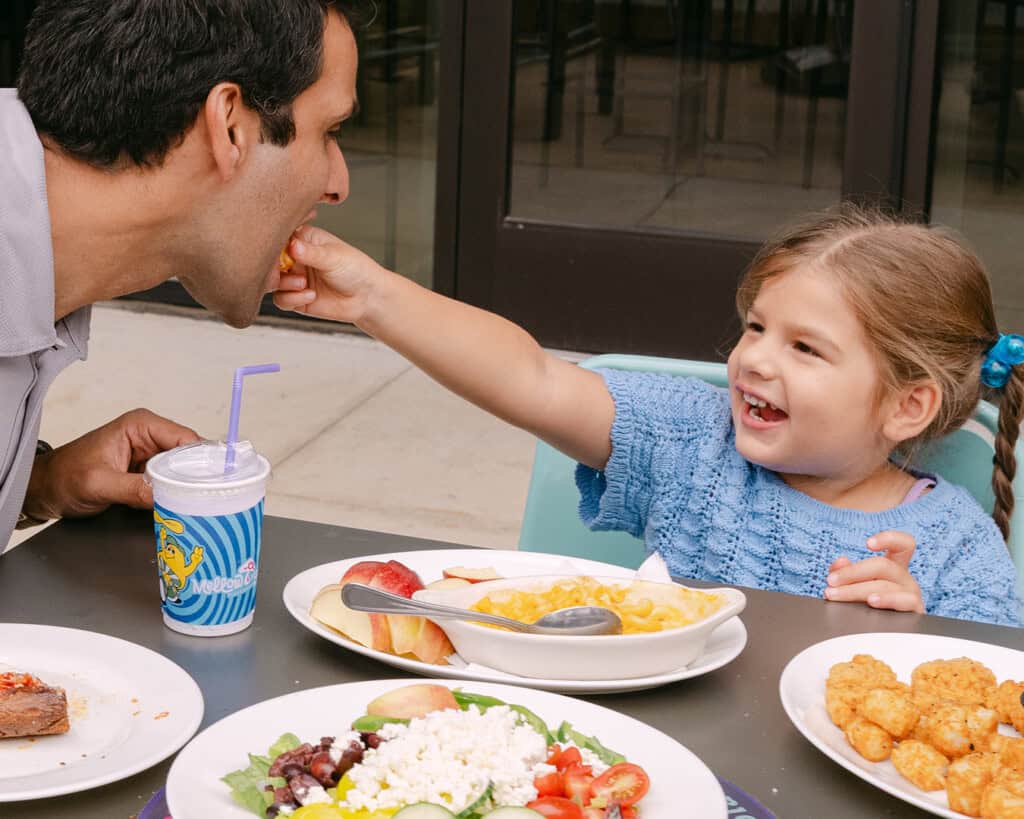
 All kids menu items at Mellow Mushroom come with a kids drink and choice of tots or apple slices.
“It’s really all about making it easy for the parents… so that they can sit there and enjoy themselves and not have to stress over what their child is going to eat,” says Elizabeth Brasch, EVP of People and Brand at Mellow Mushroom.
We spoke to four Atlanta restaurant leaders, and a surprisingly consistent philosophy emerged. All of them offered a kids’ menu that had started as a short list of age-appropriate choices but had become a sophisticated extension of the overall brand experience. Portions get smaller, choices get streamlined, but these restaurant leaders agree that the priority stays the same: quality, presentation and value.
 Tal Baum
The Menu Builds The Brand
At Bellina Alimentari, part of the Oliva Restaurant Group, the kids’ menu offers smaller portions of pasta with olive oil and Parmigiano or a simplified ragù, created by the same kitchen that serves the adult menu. “Everything is made from scratch,” says owner Tal Baum. “We want to make sure the kids are enjoying the same quality as the older diners and ensure the quality and the experience is matched.”
Portion sizes at the five metro-Atlanta locations of Superica, a Michelin Bib Gourmand Award recipient, take quantity into consideration. Culinary Director Marcelo Han explains, “What changes is quantity, not quality. A child might get two tacos instead of three, but the tortilla, the protein and the seasoning stay the same.”
Han sees an added benefit in staying true to the original flavors rather than stripping them out. Mexican cuisine builds flavor in layers—cumin, chile, aromatics—and Superica doesn’t remove those layers for younger diners. “That’s something we don’t talk enough about,” Han says, “how kids learn to eat those layers of flavor. Kids start to experience how those flavors work together, an early, informal introduction to a cuisine and a culture.”
NFA Burger owner Billy Kramer takes a simpler view. NFA did not have a kids’ menu when it opened. “The whole menu is a kids’ menu to me,” he explains. After receiving a one-star review criticizing the omission, Kramer essentially put the restaurant’s single burger in a kids’ section. The kids’ cheeseburger is adjusted for younger tastes with a single patty, cheese, no seasoning and no toppings, but it is fundamentally the same burger.
 The goal of offering a great kids’ menu is often to make life-long regulars.
Hospitality Comes in Kid Sizes
Hospitality for little diners looks different, but the goal is the same: take care of the guest. It begins with training staff to understand the different rhythm and needs of a family meal. It can mean Bellina Alimentari’s coloring pages and crayons, Superica’s complimentary kiddie pops, or NFA Burgers offering a small pull custard when a child is having a rough moment.
For Mellow Mushroom, hospitality for kids is folded into the operational details. “It’s not just about what’s on the menu. It’s also about having highchairs readily available and proactively bringing over the highchair,” Brasch says. “Making sure you’re asking the right questions to the parents to get them settled right away.”
Often it’s as simple as getting the kids’ meals out first. When kids are comfortable, parents relax too.
 Marcelo Han
Family Is The Growth Opportunity
Each of these restaurateurs acknowledged that family dining is no longer a side consideration; it’s a growth strategy. “We have three generations of regulars—from grandparents to their sons and daughters to their kids—coming to our restaurants,” Han says.
Kramer describes a regular customer who brings his son to NFA once or twice a week. The child calls it “the best burger he has ever had.” For Kramer, that is loyalty, built less through gimmicks than by consistently serving good food and making customers feel cared for.
The real customer isn’t always the child. It’s the parent getting everyone fed after soccer practice. Children are also driving more of the decision than they used to. “Mom, Dad, I saw this restaurant on Instagram, can we go there Saturday night?” is how Baum describes it. Brasch sees the same shift at Mellow Mushroom where kids are “much more at the forefront of knowing what’s out there,” she says, “and making those requests themselves.” At NFA, the influence is more direct. A child likes the burger, asks to come back, and becomes the regular who brings the adults along.
Kids, in other words, aren’t just along for the ride. They’re increasingly the reason for the reservation.
But Does It Make Money?
These menus might not make money using a standard pricing formula, but that may not be the point. “Our margins are a lot smaller on the kids’ menu,” Baum says. She treats that as the cost of being the restaurant families choose. At Superica, Han expects the kids’ menu to hold its own. “We make the kids’ menu so that it at least breaks even, and we design it to profit about 10–15 percent,” Han says, “even though we use adult‑level ingredients.”
Kramer won’t discount at all. “All that food costs the same amount of money,” he says, and he sees no reason a burger should cost less because of who’s eating it. Mellow Mushroom takes yet another approach, treating its “Kids Eat Free Tuesday” promotion as a traffic and loyalty play, rather than a per-plate profit center, and the group is reporting a real bump in Tuesday visits since it launched.
Four restaurants, four different answers to the economics question, but the same conclusion: a good kids’ menu may not be measured by what it earns on its own. Its value is whether it gets the whole family in the door again. The kids’ meal may be the smallest line on the receipt, but it’s often the biggest reason a family comes back.
Han may speak for the others when he says, “We don’t sacrifice quality because it’s a kids’ offering. Kids deserve the same ingredients and care as adults, and that’s how you build lifelong guests.”

Toby Bloomberg has been called a social media “O.G.” Her adventures in food social media began in 2006 with the launch of the first culinary character blog for Gourmet Station. Since then, she’s worked with chefs, restaurants and independent food producers on how they tell their story online. She is a member of Les Dames d’Escoffier International’s Atlanta chapter.



