By Helen K. Kelley
While restaurant owners are always seeking out ways to increase efficiencies and improve the bottom line, they are also continuously working to enhance the customer’s experience and satisfaction. New and evolving technologies provide restaurant owners and managers with innovative ways to achieve these goals.
Tapping Into Potential
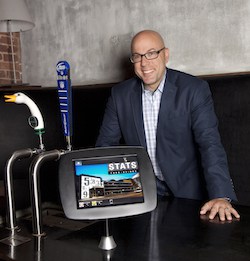 Jeff Sime
One area where technology has helped make the diner’s experience more positive and improved the restaurant’s bottom line is in beverages. There are several self-serving beer and wine dispensers on the market that can help make the diner’s experience more enjoyable, track what beers and wines are popular and how much is consumed, and enhance the waitstaff’s ability to serve customers well.
STATS Food + Drinks in downtown Atlanta serves a lot of beer. Located in the heart of the city’s tourism district – which includes the Georgia Aquarium, the College Football Hall of Fame, the National Center for Civil & Human Rights and more – and a short walk from the Phillips Arena and Georgia Dome, it welcomes lots of tourists and sports fans alike.
The restaurant features five bars, 70 high-definition TVs and nearly 16,000 square feet of restaurant and private event space. It also features table-top beer dispensers built into nearly a dozen of its tables.
Seven years ago, the restaurant was the first in the U.S. to install TapTable units, which feature two kegs and taps through which diners may self-pour their own beers without ever leaving their seat. After a contained hood fire caused the restaurant to close for repairs last fall, the restaurant’s team decided to upgrade their beer systems to the TableTender beer dispensing system (www.thetabletap.com).
TableTender is a long-draw glycol-cooled beer system with taps located on the tables. The kegs are remotely located inside a cooler and the beer lines are run out to the tables, hidden in the floor, through walls or in the ceiling of the establishment. Glycol, a liquid chemical that can maintain relatively low temperatures, is circulated throughout the entire piping network to ensure the beer is ice cold once it is poured into the glass.
TableTender monitors the amount of beer poured to provide accurate and user-friendly reporting. Each table has its own display, featuring the quantity of ounces that have been poured from the tap, and records real-time information. Flow meters and valves, designed specifically for beer, allow the system to control and record the flow. The dispense information is also transmitted to the TableTender software, which allows management to view dispense data and run reports.
The TableTender beer dispensing system has increased both pouring efficiency and guest satisfaction at STATS Food + Drinks, according to Jeff Sime, vice president of operations for Legacy Restaurant Partners, which operates STATS and multiple other restaurants in the Atlanta area.
“We upgraded to the TableTender system so that we could monitor and enhance the beer service at our tap tables at Stats,” he says. “There are two separate taps available at each table – one dispenses a common domestic brand of beer and the other dispenses a craft brand. Guests can choose to sit at a table that has a beer they prefer or would like to try.”
Orders are placed and regulated through a tabletop iPad system that shows guests exactly how much they’re drinking, down to the ounce. With its regulating and reporting features, TableTender ensures that management has the necessary controls on the system to promote responsible drinking.
The benefits for the restaurant are threefold – it keeps waitstaff from having to constantly bring refills, which then allows them to better attend to their guest’s other needs, and every drop is paid for by the customers, including any pour off. Plus, managers are able to track trends in customer preferences, comparing sales of different beers as well as determining which tap tables have the highest sales.
If a particular beer isn’t selling well, management can change out that keg for a different beer. Tabs are run at a main portal and later, the information is taken from that portal and run through the restaurant’s POS system to generate the customers’ bills. Sime says the system’s tracking capability is probably its most important feature.
“TableTender provides an inventory reconciliation function that tracks every ounce of beer that’s being dispensed through the draft lines at each table,” he says. “It eliminates the possibility of human error, such as overpouring a glass or accidentally filling a glass with the wrong beer and having to discard it,” he says. “We know exactly how many ounces have been consumed, and the customer is billed for every ounce that he or she pours from the tap.”
As for the guests, they experience the convenience of immediately pouring a glass of their chosen beer, without having to wait for a server. Plus, they don’t have to leave their table. In turn, this self-serve capability creates a more efficient system for servers.
“The server doesn’t have to take the order, go to the bar, wait for the bartender to fill the order and then return to the table,” Sime says. “Servers are able to spend more quality time with the guests, ensuring that they’re being hosted appropriately, and attend to their other duties more efficiently.”
When asked if there were any challenges in implementing TableTender, Sime says there have been only a few small difficulties, such as the need to change out kegs of beer more frequently for larger parties.
“The efficiencies far outweigh any of the smaller issues we’ve encountered with the technology,” he says. “Making the upgrade to the TableTender technology was a great decision.”
Uncorking Opportunity
 Riccardo Ullio
Novo Cucina, the new restaurant concept by Atlanta chef Ricardo Ullio, features an innovative way to both serve wine and save on the bottom line.
Using the Enomatic wine system, the restaurant’s wines are held unoxidized and at the perfect temperature, extending freshness and preserving them for up to four weeks after opening. This gives restaurants the freedom to expand their wine list or even offer tasting menus without worrying about wasting a whole bottle of wine when it’s ordered by the glass.
When a diner orders a glass of wine, the system dispenses the liquid directly from the bottle using inert gas preservation, preserving the flavors and characteristics of the wine for more than three weeks as if the bottle had just been opened. Waitstaff can input the exact amount of wine to be poured each time. This allows guests at Novo Cucina to sample its wine offerings before deciding on a glass.
The system helps regulate portion control, allowing the restaurant to virtually eliminate waste due to overpouring or mistakes in selection. And, it also self-cleans the pouring spouts after each pour to ensure maximum hygiene.
“We offer a refreshing list of boutique wines at our wine bar,” Ullio says. “The Enomatic ensures that our guests can sample whatever they desire and then enjoy a perfect glass of wine, every time.”
Ullio and partner Mike di Paolo also implemented a unique card system that allows patrons an easy way to explore the restaurant’s many offerings.
The restaurant features a “greatest hits” of menu items from Ullio’s other intown Atlanta restaurants, Sotto Sotto and Fritti. It also has a unique way for diners to pay for their meals.
“The card, which is the size of a credit card, can be used for your tab from the moment you walk into the restaurant,” Ullio says. “Whether you order something from our wine bar or gelato counter, enjoy cocktails or coffee, or place an order from your table, each transaction is recorded on the card for the duration of your visit. Then, you simply pay on your way out.”
Di Paolo engineered the card system, which has created an unprecedented level of convenience for customers. In addition to keeping track of customers’ tabs, the cards provide an easy way to create separate checks for individual customers or divided parties.
“The card removes the worry of transferring items among customers,” Ullio says. “With individual cards, customers don’t have the hassle of dividing up the check at the end of their meal – and they only pay once.”



