 Consider adding natural wines to your list for guests wanting more transparency.
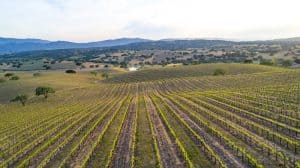 Consider adding natural wines to your list for guests wanting more transparency.
By Cole Younger Just
The importance of sourcing ethically and mindfully produced ingredients continues its tour de force in the food world, with an overwhelming amount of information revealed through labeling and transparency.
While the same has not been true in the multi-billion-dollar global wine industry, that is starting to change. The wine world is now undergoing its own revolution, in which every step of the process is being scrutinized by beverage managers and guests alike. As more look to where and how their food and drinks are made, natural wines are growing in popularity. So is it time to add some to your beverage list?
How We Got Here
Wine in its truest and purest form is a metamorphosis of crushed grapes into a living liquid via fermentation, yielding a beverage bursting with microbiology. For millennia, this was how wine was made.
Then came along the post-WWII-era philosophy, “Better Living through Chemistry,” which for better or worse led agriculture, including the wine industry, down a path that in theory was well meaning but was glaringly short-sighted.
“Winemakers” became further detached from the field and soil, which is the lifeblood of the vineyard. Wineries became heavily dependent upon chemicals that provide short-term solutions to what would become nightmarish long-term problems.
By depriving the ground of vital organic nutrients via organic composting and manure fertilization around the vines, the soil became increasingly out of balance. This led to undesirable molds, mildews and fungi, which soon led to unwanted pests feasting on unhealthy vines.
The short-term solution? Spray. Spray for mold. Spray for mildew. Spray for pests. Spray for any and every threat, be it immediate or preventative.
Vintage after vintage, this cycle became a self-fulfilling vintners nightmare, yielding grapes with more and more flaws that then had to be corrected in the cellar before, during and after fermentation.
The amount of intervention in the cellar devolved as much if not more than what was happening in the vineyard. Indigenous yeasts that are the catalyst of spontaneous fermentation of grape juice, a process that is one of the hallmarks of the terroir of a wine’s sense of place, were rejected for highly cultivated yeast strains created in the sterile labs of the 1960s and ’70s. Some 100 to 300 different additives can be used to define a brandmaker’s style of wine, and when used in certain dosage amounts, these do not legally need to be indicated on the label.
The natural wine movement came about in response to these events. Natural wine is honest wine; it’s a living thing in a bottle that is organically if not biodynamically produced in the vineyard where almost nothing is added nor taken away in the cellar.
While much of Europe (specifically France and Italy) are already years into the natural wine revolution, here in the U.S. it’s just now gaining traction. At the RAW Wine Fair in Brooklyn this fall, I got to experience some of the amazing things happening in this sector of the industry and got a better understanding of what natural wines are and how you can add some of these great bottles to your wine list.
Biodynamic vs. Organic
Natural wines can encompass both biodynamic and organic wines. Biodynamic agriculture, the first intentional form of organic farming, began in 1924, when Austrian esoteric philosopher Rudolf Steiner gave a series of lectures published in English as The Agriculture Course. Steiner is considered one of the founders of the modern organic farming movement.
Biodynamic agriculture treats soil fertility, plant growth and livestock care as ecologically interrelated tasks, emphasizing spiritual and mystical perspectives. While the whole astrological significance it places on farm practices can be hard for some people to get behind – sowing, harvesting and bottling all by the moon cycles – there is some relevance, not least of which is the gravitational pull of the moon on the earth and on the liquids of which grapes are mostly comprised.
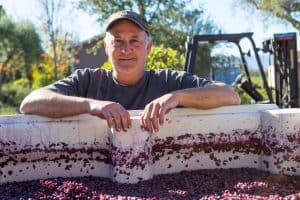 Steve Beckman of Beckman Vineyards.
Organic farming, meanwhile, disavows the use of industrial chemicals in the form of pesticides or fertilizers. Not terribly complicated in its definition, but the narrative often stops there in the world of wine. It’s not concerned about the cellar practices, which can include a laundry list of intervening methods to engineer the wine to one’s desired effect. While organic wineries are not necessarily engaging in intervention post-harvest, there does not currently exist a de facto agency claiming otherwise.
There are several agencies that attempt to get at the elusive definition of natural wine, like AVN L’association des Vins Naturels, or Les Vins SAINS in France and VinNatur in Italy. Demeter International is one of the main certification organizations for biodynamic agriculture. Then there is Vin Biologique and Agriculture Biologique, which is the European Union’s organic certification. And of course there’s the USDA Organic certification here.
Needless to say, not all countries are in agreement about these standards, causing confusion around the term natural wine. Furthermore, the word “natural” is a word fraught with controversy in both the food and wine world, setting up a battle with natural wine enthusiasts on one side and conventional wine advocates on the other.
Should You Add Natural Wine To Your Program?
Politics aside, when determining if you should add a specific natural wine to your list, defer to the juice in the bottle and let your palate be the judge. Then ask some philosophical questions about what you just tasted:
1. Is the wine good?
2. Is this wine being made in a way that nurtures or depletes the earth from which it came?
3. Do I feel better off knowing the transparent practices of this wine? Does that matter to me?
4. Am I safer/healthier putting something in my body that is organically/biodynamically produced?
Regardless of your answers to these questions, remember that discerning guests are paying closer attention to which wines to trade their hard-earned pay for. While natural wines may not resonate with you as a buyer or operator, they may with your guests. At a minimum, it should be a best practice to be prepared to intelligently field questions from guests relating to natural wine and explore having a few natural wines on your list.
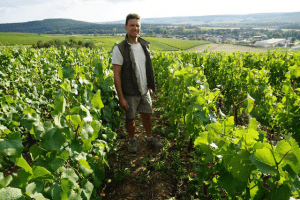 Vincent Couche of Cotês Des Bar in France uses only natural products, and the field is certified biodynamic. Source: Sour Grapes
What To Look For When Adding Natural Wines
Where to start? First, talk with your wine distributor representatives. In the Atlanta area, there are several distributors that have a large selection of natural wines in their portfolios.
Sour Grapes, owned by Sarrah Wile and Devon Price, is a smallish distributor out of Asheville, N.C., that has brought a large selection of natural wines to the Atlanta area. Avant Partir, with Nicholas Montigelli pedaling its wares about town, is another fantastic resource for all things natural wine. Prime Wine & Spirits, too, have done a great job in fleshing out their portfolio with natty wines as well.
Using SevenFifty (go.sevenfifty.com) as a resource can also be invaluable to research importers and who distributes them. For instance, Integrity Wines, headed up Doug Strickland here in Atlanta, is an importer dedicated to the natural wine movement and is distributed by multiple distributors here in the Atlanta area, like Georgia Crown and Savannah Distributing Co. to name a few.
Then there are exclusive relationships like Louis/Dressner Selections and PortoVino, which both have an exclusive relationship with Avant Partir to distribute its portfolios.
Lastly, there are some importers that may not be exclusively natural wine, however they do have a great showing that would certainly warrant exploration. These are importers like Domaine Select – multiple distributors, and Kermit Lynch – also multiple distributors. Each of these bigger importers generally have their own ambassadors who know their portfolio inside and out and are chomping at the bit to have a discussion with the buyer about meeting your natural wine needs.
While natural wine still represents a small sector of the wine industry, it is a growing category within the sustainable and organic food movement. That’s why it’s important for us as an operator or buyer to educate ourselves. The natural wine movement is gaining ground in the old-guard wine world, and we owe it to ourselves and our guests to learn about these winemakers and their painstaking efforts to produce something honest and evocative of the land from which it comes.
We may not be able to ditch every conventionally grown or produced foodstuff from our restaurants and bars and immediately replace them with natural or organic offerings. However, we can give some of these producers a chance to prove their worth on our wine lists. Ultimately, it’s about satisfying a guest’s desire to pair their meal with wine that is grown and produced in the same ethical and mindful way as the food our restaurants’ chefs are putting in front of our guests.
History of Natural Wine
Natural wine has been made, of course, throughout history, but the movement of natural wine in response to chemical farming and additive winemaking started in the 1980s.
Pioneers like Marcel Lapierre and Jules Chauvet in Beaujolais just south of Burgundy proper in France adopted the practices of going sulphur free and farming without the use of pesticides or chemical fertilizers back in the 1980s.
After a decade and half or so of experimentation, their methods finally proved fruitful and their methodology soon spread outside of Beaujolais, into the Loire Valley, then across France and into Italy and the rest of Europe. Eventually this movement gained wide-ranging appeal, and its traction progressed worldwide. By the 1990s, these types of natural wines began to make their way to the U.S., and the movement started to gain steam in the 2000s.
Raw State
This past fall, RAW WINE New York was held over a two-day period in New York City. The event featured more than 100 growers of natural, organic and biodynamic wine. Nearly 3,500 people attended the event over two days.
Raw Wine is the world’s largest community of low-intervention organic, biodynamic and natural wines, their growers and makers, and those who love drinking them. Raw Wine events are held throughout the world, including in New York, Montreal and Los Angeles. (The next one will be held in London March 10-11.)
According to Raw Wine, natural wine is farmed organically and made without adding or removing anything in the cellar. No additives or processing aids are used, and “intervention” in the naturally occurring fermentation process is kept to a minimum. Neither fining nor (tight) filtration are used. The result is al living wine full of naturally occurring microbiology.
To be included at a Raw Wine event, the wine must:
• Use organic grapes, grown without the use of artificial chemicals.
• Be prepared by hand using artisanal techniques.
• Be made using traditional winemaking processes that enable balance.
• Be a living wine, created with low intervention in the cellar.
• Promote wellbeing in individuals and communities.
To see some of the low-intervention organic, biodynamic and natural wines available to serve at your restaurant, go to rawwine.com
Source: RAW WINE
 Cole Younger Just is co-owner of Atlanta- based Just Walk Consulting, where recent clients have included Full Commission and Old Fourth Distillery. He was previously beverage director at Bellina Alimentari,The Cockentrice and Last Word. He’s originally from the New Orleans area, but has called Atlanta home since 1996.



