From Laotian and Filipino to Korean and Taiwanese, more cultures and their foodways are being represented across Georgia’s restaurant landscape
By Nancy Wood
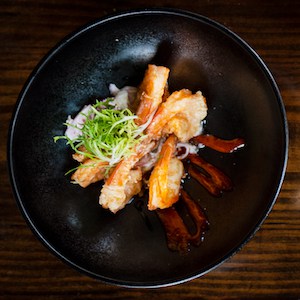 Char’s shrimp tempura
The explosion of the Asian food craze can be attributed to several factors – a strong demographic shift in the number of Asian-Americans living in the U.S., the upswing in Millennials and Gen Z consumers who want to experience new foods, and American diners who are ready for bolder flavors.
It’s no secret that shows like Iron Chef and the adventurous dining brought to life by the likes of the late Anthony Bourdain and Andrew Zimmern opened up the eyes and mouths of Americans. Watching those experiences sent people in search of the latest Asian street fare and the spicy flavors they wanted to try.
With all these influences, there’s been a shift in people’s general perception of Asian cuisine. Long-outdated stereotypes are being pushed to the side as a new generation of chefs and restaurant owners share their takes on Asian cuisine, respecting traditional foodways while creating new and innovative dishes.
Fortunately, in Georgia, diners don’t have to look too far to find the tastes they crave. The next generation of chefs and owners are putting their own twist on nostalgic family recipes, and American palates are being regaled with new flavors and dishes from distinct regions of Asia.
New Takes on Authenticity
From Laotian to Taiwanese, Korean to Filipino, the breadth of cuisine offered in Georgia is wide ranging. But what is Asian food? Using the United Nations’ standard definition, there are 48 countries in Asia, reaching all the way across India west to Yemen and Turkey. Culinary-wise, however, Asian food typically refers to the countries along the Pacific Ocean – East Asian (Chinese, Japanese, Korean, Mongolian and Taiwanese) and Southeast Asian (Malaysian, Burmese, Singaporean, Indonesian, Thai, Filipino, Cambodian, Laotian and Vietnamese).
And while a generation ago the typical American may have eaten just a few types of Asian food, today’s diner is much more open minded and eager to try the foods of different cultures around the world. And restaurants owners are happy to oblige.
 Richard Tang, owner of Char Korean Bar and Grill
“We’ve had the first generation of Asian concepts, and now we’re having their kids taking over and trying to evolve the second generation,” says Richard Tang, owner of Char Korean Bar & Grill in Atlanta. As a first-generation restaurateur, Tang feels the challenge of both educating and pleasing the American palate. His view is that everything is a continual educational process. “A lot of people are just content with what they’re used to,” he says. “We’re definitely a modern take on Korean food.”
Even with the proliferation of Asian-inspired restaurants, the urge for chefs to connect with their diners is continually top-of-mind. In fact, eight years ago, when Kaleb Harrell and his three partners opened the first Hawkers Asian Street Fare in Orlando, Fla., based on the infamous hawker stalls found throughout the continent but most famously in Singapore, “we were so worried that people weren’t going to understand what this food was about, we actually put TVs around the dining room and looped Anthony Bourdain and Andrew Zimmern episodes,” he says. Hawkers opened its first Atlanta location this summer in the Old Fourth Ward neighborhood to much buzz.
But actually introducing diners to regional Asian flavors takes more than a TV show – it can be a different kind of education, says Steven Chan, founder of franchise Tin Drum Asian Kitchen. “I would argue that it’s not the flavor profile itself that needs any sort of introduction,” he says.
“Our senses and how they work within our mouths are the same as how we discern flavors from Italy, Mexico or China. It’s more from a marketing and education standpoint,” he adds, “and it’s our job to find and serve the right kind of product that can talk to the consumer effectively. We try to strike that balance where we’re here for all people.”
To emphasize that point, Tin Drum divides its menu into two sections: In a Bowl and Not in a Bowl. “The ‘In a Bowl’,” says Chan, “has Asia’s greatest hits like sesame chicken or teriyaki stir fry.” The ‘Not In a Bowl’ is more Asian Fusion. “It’s more like a Japanese ingredient that plays into a Chinese execution. I would say it’s more unfamiliar.”
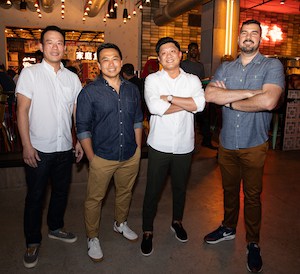 Hawkers’ Kin Ho, Wayne Yung, Allen Lo and Kaleb Harrell
The Rise of Regional Tastes
Geography plays an important role in the focus of these evolutionary restaurants – and in the trends popping up around the country.
Today, it’s not simply just a Chinese restaurant, but a place specializing in one of China’s eight regional cuisine styles, from Cantonese to Sichuan. Dumplings are having a moment, whether they’re crescent shaped Jiaozi-style or xiao long bao – sometimes called soup dumplings. The Japanese Katsu sando, Korean bibimbap, Filipino lumpia – these and other dishes are increasingly being seen on menus across the country. Not to mention the trend of fusing Asian ingredients or cooking styles to other culture’s cuisines – think sushi burritos or tempura french toast.
While Tang incorporates some Japanese flavors into his Korean dishes at Char, he explains that as far as certain cuisine aspects, they play off of each other. “I think it’s the culture and how close they are as far as a destination.”
“If we speak in generalities,” says Harrell, “the American palate has evolved immensely in the last 10 years. Historically we thought ‘oh it’s Asian food,’ but it’s so much more than just lumping it all together. You’re talking about places that are 1,000 miles apart,” he says, “with completely different climates and completely different food.”
Harrell points out that food from the northern region of China includes bitter melon and ‘brothy’ soups. While in Malaysia and Thailand, the food is extremely spicy. “We try to represent different parts of Asia – Malaysia, Korea, Thailand and several different regions of China,” he says.
For Chan, a Hong Kong native, the move to incorporate a variety of Asian dishes came after many years working with his wife’s family running a full-service Thai restaurant. When he opened the first Tin Drum in 2003, he says, “I wanted to try something new that incorporated a lot of the other food from Asia.”
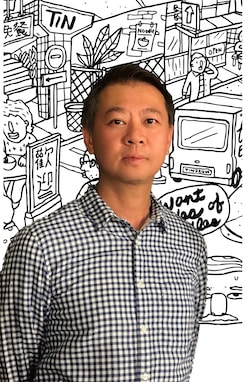 Steven Chan of Tin Drum
Chan says his recipes are 95 percent from his mother-in-law and his wife, so they are very personal renditions of authentic Asian recipes. “My mother-in-law, who is a terrific cook, is Chinese and grew up in Laos, so she knows how to cook all the Southeast Asian food,” he says.
But he is quick to point out that the products they sell represent an interesting spin on Asian food. “We never claim that we’re authentic in, for example, how you make a pad Thai in Bangkok. Tin Drum’s food is a very good alternative to so-called authentic flavors.”
Those authentic recipes played a role in the menu development for Hawkers as well. Harrell and his longtime friends and partners, Wayne Yung, Allen Lo and Kin Ho, traveled together for many years “always in search of the best food” before opening their first location.
But the basis for about half of their dishes comes straight from family recipes shared during their annual “Friendsgiving” feast. Yung, Lo and Ho’s families all come from different regions in Asia, and as Harrell says, “All these relatives were coming out of the woodwork with these really incredible dishes.”
Sourcing Asian Ingredients
Regardless of the type of Asian food being offered, the current growth in the segment has made sourcing what some may consider hard-to-find ingredients less difficult than it used to be. Consider Chan’s experience sourcing the buns for his sandwiches.
“Fifteen years ago, I had to go to Buford Highway every morning and buy the Vietnamese baguette from Lee’s Bakery,” he says. “These days, H&F makes a very good version of that 6” baguette, and I didn’t have to give them a recipe.” He says the same thing about the ubiquitous sriracha sauce: “These days you can buy it from anybody.”
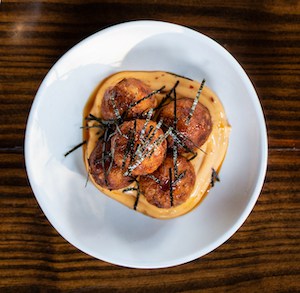 Char’s takoyaki
Tin Drum has 10 restaurants scattered throughout the Metro Atlanta area, and Chan says that because “we are multi-unit, we are able to find Asian distributors that have pretty much everything that we need.” Char’s Tang agrees. “People don’t realize there are Asian vendors that sell products. You just have to know where to look.”
For Hawkers Asian Street Fare’s 10 locations throughout Florida, Georgia, Tennessee, North Carolina and Maryland, Harrell has a different take.
“It’s a struggle,” he says. “We try to rely on local ingredients when we can, but I have to be honest, it’s tough to find, particularly, the Asian ingredients.”
Some of the ingredients his restaurants use – like the peppers, curry leaves and lemongrass – have to be procured straight from overseas, and the quality may not be up to par. “When we get dried Szechuan peppers from some distributors, if they sit in a warehouse for too long they end up losing some of their flavor,” he says. “So it changes your whole dish. You could go down a list of 100 ingredients that fall into that category.”
The Effect of the Experiential Diner
The difference in how consumers dine today has had a big influence on the current iterations of Asian-focused restaurants. With the uptick in popularity of delivery services, restaurants are looking for ways to entice patrons to dine in. What are today’s diners looking for? A mix of authenticity, good service, a great bar program, and, most importantly, a real experience.
“To me,” says Harrell, “there’s a gap between consumers who want something really quick and consumers who want a really great experience. If you’re in the middle, I think consumers feel that one or the other has been diluted. They sometimes get overlooked, so we try to go really heavy on the experience side of what we do.”
“The market has changed since the decline of the economy in 2008,” Tang says.
Tang, whose Inman Park restaurant lies just a few steps from the Atlanta BeltLine, has amped up his bar program as well. “The experiential part is already here,” he says. “I think that if people don’t change and make that happen, they will die.”
“Historically,” says Tin Drum’s Chan, “my experience with a restaurant is you come in, you sit in a certain way, you are offered a product on the table, you consume it, you pay a price and you leave. It was an independent experience.
“These days,” he says, “retail is experiential. Putting a multiple experience into a physical place, we can be more of an attractor for the public. It’s how we need to evolve in order to survive in the 21st century.”
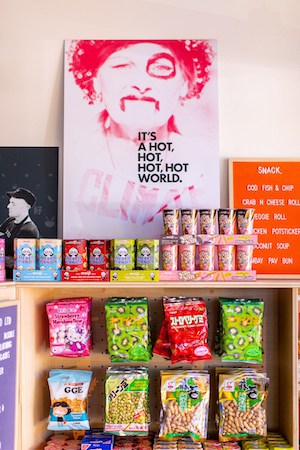 Tin Drum retail section
A few months ago, Chan even created a new position, Manager of Environment, and started incorporating retail shops in his restaurants. “It’s an extension of our Asian culture that provides the public with things that are affordable, which is part of our brand,” he says. They now offer snacks, candies, bottled drinks, Dorito chips with an Asian flavor “and even those pimple patches,” he laughs. “It’s a lot of fun and makes the place more vibrant.”
The Flavors of the Future
Despite the challenges of a changing industry, trend spotters think the Asian segment will continue to grow, particularly Southeast Asian food. And the execution of the food and the experience will continue to be a factor.
“In Georgia, I’m excited about the new generation of Asian restaurateurs who are continuing to push the envelope,” says Chan, “and they should be celebrated.” In Atlanta particularly, he’s seeing Asian female chefs who are doing pop-ups that specialize in Filipino, Laotian and Korean food. “These are new flavors and new items we are introducing to the public, so it is our obligation to put forward good products.”
The increased interest in Laotian food is a trend Harrell is seeing as well. “Holistically, the whole street food piece is big,” he says. “We’re seeing restaurants specializing in food from street stalls in Laos or Cambodia.
“Every time I go to Asia, I try something new and different and unique,” he says. “We’ve got almost infinite potential in seeing the street food piece expand, because there are so many flavor profiles and so many different options.”
“I’m happy that we are able to evolve,” adds Tang, “and that people are starting to enjoy the modern take on Asian cuisine. It’s a good opportunity for the Asian market to captivate their audiences.
“You only have one chance to make a first impression,” he adds. “At this moment, people are really enticed and curious, and that means we must make sure we’re doing our jobs as restaurateurs to provide them with the experience they should and will get – and deserve.”



