Now that dining rooms are opening across Georgia, things will look different. Here’s how.
By Christy Simo
Many restaurants have accepted that the old way of operating is gone and are rethinking what it means to be a restaurant. That means not just moving tables 6 feet apart and temperature checks at the door, but also reconsidering the entire front of house and its purpose.
“Everything is on the table,” says Ed Seiber, founder of Atlanta-based Seiber Design, which has created spaces for restaurants across Georgia like Aria and Ray’s on the River in Atlanta, City Pharmacy in Covington and Bone Island Grill in Eatonton. “Layouts will change at least until a vaccine is available.”
 John Bencich, founding principal of Square Feet Studio
John Bencich, founding principal of Atlanta-based Square Feet Studio, agrees. His firm specializes in restaurant design and has fashioned spaces for Little Bear, Southern Belle & Georgia Boy, Staplehouse and C. Ellet, among others.
“I really believe that restauranteurs are a uniquely creative group,” he says. “I am sure design changes are coming, but I expect to be surprised by some of the suggestions and requests we will hear.”
No matter what changes you implement at your restaurant, it’s critical now more than ever that you ensure everything – from sanitizing efforts to signage to how your servers interact with guests – contributes to a better dining experience. And the key to ensuring those guests return for a second visit now rests on their ability to trust you.
But how can restaurants maintain a sense of ambiance given new protocols put in place to keep everyone safe?
“We have to attempt to keep anti-microbial from being perceived as anti-hospitality,” Seiber says. “We will have to discover how to be subtle about new measures so we don’t drain the last drop of hospitality from our restaurants.”
While many restaurants had to react quickly to survive the initial lockdown phase of the pandemic, now it’s time to reassess what’s working, what guests will want and need, and what can be phased out as we move into a socially distanced future. Here’s a look at some of the main ways restaurants are figuring out how to move forward.
Spacing Out Seating
The most obvious change is where guests will sit. Directives are ever evolving. At first, Georgia’s state-mandated guidelines only allowed six people at a table, with only 10 people per 500 square feet of dining space. That mandate was adjusted on May 12 to 10 people per 300 square feet and up to 10 people per table.
And while bars were originally required to stay closed, as of June 1 they can now reopen – but with their own 39 guidelines to be met, including those being served drinks must be seated or in a designated area and limiting the number of people in the building to 25 or 35% of total occupancy.
That’s led to all kinds of creative ways to keep people separated and feeling safe as they remove their masks to eat and drink. Creative partitions have included clear and tinted plexiglass stands, rows of potted plants and even hanging shower curtains between tables.
With filming currently on pause, one Atlanta company that before the pandemic catered to the TV and movie industry, Cinema Greens, is now offering “living sneeze guards” that provide a more aesthetically pleasing alternative.
“Other than more space between tables, I think we’ll explore creative ways to provide a sense of separation without visually isolating guests from each other,” Seiber says. “After all, one of the reasons we go out to dine is to see and be seen.”
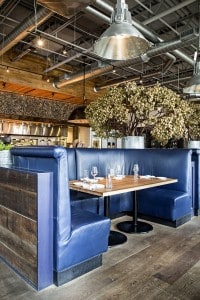 More restaurants may choose to add higher backed booths, like these at Colletta in Alpharetta, to the dining area.
Seiber is starting to see other alternatives like higher backs on booths, decorative low walls and drapes to separate guests while also keeping the space from feeling too sterile.
Now that bars are allowed to reopen, that will invite more creative solutions to the spacing out guests challenge.
“In the short term, we are already seeing bar seating spaced as two stools, three spaces, two stools, three spaces to create social distancing for couples,” Bencich says.
Look for some seating trends to fade away, maybe even for the long term. Those long communal tables that have been so popular? Don’t count on those coming back anytime soon.
“For the short and medium term, I expect to see smaller flexible semi-private dining options, almost with a dinner party sense for small groups from six to 10,” Seiber says.
Experiments abound. One restaurant in Paris has installed lampshade-like plastic shields called Plex’Eat. Another in the Netherlands, Mediamatic ETEN, has created individual greenhouses in which two can dine comfortably outside. Waiters serve food through a sliding door on a plank for true contactless serving. (Reservations are booked solid from when it opens June 1 until early July.) Some restaurants have decided to fill empty tables with mannequins or cardboard cutouts of people dining to make the area feel less empty.
Visible and Invisible Efforts
It’s important to send clear visual signals that your restaurant is taking cleanliness and sanitation seriously. Cleaning protocols that were once done discreetly are now expected to be out in the open.
Visible gloves and masks on servers are of course required, but guests will be looking for them. Same goes for hand sanitizing stations in the dining area and at the door. Some restaurants are installing plastic shields in front of cashiers and at drive-thrus, too.
“Elements like that can go a long way toward creating an environment that is still hospitality forward, but with a little more attention to those cleanliness clues,” Bencich says.
Anything guests used to touch frequently are being rethought. Beverage dispensers are moving back behind the counter. Touch-screen payment methods are shifting to online and prepayment options. At the table, silverware is individually sealed or disposable. Self-serve items like ketchup and mustard are no longer grouped on the table but come with orders as portion-controlled servings. Menus are either disposable or posted online for diners to view on their own phones.
 Ed Seiber, founder of Atlanta-based Seiber Design
Even what surfaces are made of is being rethought. “Antimicrobial finishes will be trending, and we will need to consider the ability of finishes to withstand rigorous cleaning regimes,” Seiber says.
Visible signage is key to making guests feel comfortable and safe in your restaurant. Floor stickers to show appropriate spacing have become the norm, but look for more creativity regarding how to implement messaging while also incorporating a restaurant’s brand.
“Graphics and signage have become key components of restaurant and hospitality design,” Seiber says. “I see graphics being integrated in a creative and playful way to encourage safe and healthy behavior, something more than marks on the floor and tuned to each restaurant style.”
There’s also an opportunity in those ubiquitous masks. Companies are now offering custom printing, with the ability to add a logo, slogan or subtle social distancing reminders on the masks.
Other upgrades are invisible but just as important. Some recent studies have suggested people may be more susceptible to contracting COVID-19 within enclosed spaces, especially if they are within the space for a lengthy period of time. As a result, some restaurant owners are choosing to invest in upgrades to their HVAC systems, such as using high-efficiency filters.
Many potential guests may be hesitant to dine in within the restaurant’s four walls but may be more open to eating outside in the fresh air.
“Covered, seasonally enclosed outdoor spaces have been in high demand even before the pandemic,” Seiber says, adding that they’ll be a key component for restaurants going forward. “I expect to see larger outdoor dining and more operable walls and windows incorporated into restaurant design.”
Three metro Atlanta cities (Broohaven, Dunwoody and Tucker) have already amended their rules to allow restaurants a temporary outdoor dining permit, which now expands to parking spaces and other nearby common areas. The 90-day permit is at no cost to the restaurant, but it does require permission from the landlord and a site plan for outdoor seating set up.
That falls in line with what many cities are doing, with places like Seattle and Cincinnati even closing streets to traffic to allow more robust outdoor dining options. Not only does the increase in outdoor seating create a level of comfort to encourage more diners to return, it supports the restaurants by giving them more covers.
Changing the Flow
Existing restaurant flow needs to be reconsidered. How do you get guests in and out the door while still staying 6 feet apart? Especially if restrooms are near the kitchen, how do you manage that intersection and keep staff and guests from running into each other?
Some restaurants with multiple entrances and exits are rearranging flow to encourage patrons to go in one door and walk out the other. Some are using staff as restroom monitors to ensure one person at a time enters the restrooms safely. Others are setting up host stands outside and takeout pick up stations away from the main entrance dine-in guests use.
“I’ve already seem some creative systems at Halfway Crooks in Summerhill, where they devised a system to lower your food to you in a basket from their roof deck,” Bencich says. “And at Kimball House in Decatur, where they take advantage of a long sidewalk and some Dutch doors to create a streamlined queue, pay, pick up system.”
Many restaurants are asking diners to wait in their cars until they are ready to be seated to keep people from getting too close in what was previously a waiting area in the restaurant.
Still others are using this time to completely rethink their space and are investing in more permanent alternatives. After all, people’s habits are changing, possibly for the long haul.
In Decatur, The White Bull temporarily closed for two weeks to not just to make changes like upgrading equipment BOH, but also to add floor-to-ceiling glass windows in the front of the restaurant and a back patio for more open-air seating.
New Additions
Finally, restaurants have become more than just a place to celebrate milestones and to gather with friends, dates and families. Now, they are retail spaces, general stores, sellers of ready-to-heat family meals. And with takeout accounting for 20% or more of the revenue these days, even fine dining restaurants now offer to-go orders and need a dedicated pick-up area.
“The most consistent theme I hear from a lot of restaurateurs is that they see a more clear and thoughtful to-go program as a permanent part of their future,” Bencich says. “It’s a way to capture a little bit of revenue from that segment of the public that either likes the convenience or just feels safer with the limited contact required. This will probably need to be considered in remodels and new designs so that the results are really well done.”
Retail has become a key revenue stream for restaurants and may become a long-lasting business model. Some restaurants are adding a permanent section to sell retail goods, whether that’s basics like flour, baking soda and toilet paper or more restaurant-focused items like housemade pasta and sauces. Others are making room for grab-and-go refrigerated cases near the front of the restaurant.
As we move forward, existing locations will be retrofitted to accommodate these and other changes and innovations to come. Restaurant footprints may become smaller, with more space dedicated to off-premise orders. There may be a trend toward more efficient floor plans that consider safety and queuing needs. Exterior spaces will be permanently reconfigured or expanded to accommodate more outdoor seating or better curbside pickup flow.
“There’s a possibility that once a vaccine is readily available, things will begin to curve back toward the way they were before,” Bencich says. “What is embraced and works during this time window will stay. That which doesn’t might just fade away.”
No matter what may happen down the road, what is certain is that restaurants that survive will be the ones that get creative to adapt and thrive in this new environment. Sometimes that will mean completely reinventing themselves.
“Continue to work hard to establish and build trust with staff and guests, and communicate that,” Seiber says. “But above all, adapt, adapt, adapt. Successful restaurateurs are innovators and entrepreneurs. We need them now more than ever to continue to offer us safe, hospitable opportunities to be social humans.”
If you’re having trouble reinventing yourself and letting go of your pre-COVID concept, know this: Even Noma, one of the most lauded restaurants in the world, recently announced that they will be reopening – as a burger and wine bar.
Everything is fluid these days. The very definition of a restaurant is changing. What works now will evolve as we move through this time. Everyone’s trying to figure out what to do next, but the spark of creativity – something this industry is known for – will shine through.
“Restaurateurs are a uniquely creative and innovative group of people,” Bencich says. “It’s about how they serve their guests, and how they make us feel comfortable. The little touches can go a long way. They love what they do, and that still comes through even if they are wearing gloves and we’re all squirting sanitizer in our hands before and after we sign the check. In the end, these are still the same places, same chefs, same GMs we’ve dined with before.”
Restaurants will look different for a while, but innovations and forward thinking will provide a new way forward. You can count on it.



