 We spend a lot of time talking about coffee in the United States. 72% of Americans drink coffee, and 62% of them drink coffee every day, according to the National Coffee Association. Coffee shops are everywhere, and coffee drinks can be spotted in restaurants, convenience stores and in the hands of most everyone I pass on a typical morning.
But what about tea? I’ve been hearing a lot lately about tea being a “trend,” so I got curious and did a little research.
It turns out that tea is the most widely consumed beverage in the world after water, and 80% of U.S. households already consume tea daily, according to the Tea Association of the U.S.A. Inc.
Wait, does that mean tea is actually more popular than coffee??
I love tea. I drink tea every day, hot in the morning, iced in the afternoon, sometimes herbal before bed. If 80% of America is like me, why don’t we talk about tea more than we do?
A Growing Market
The tea “trend” that everyone speaks of took hold during and following the pandemic, it seems. According to the Tea Association, tea sales grew by about 6% in 2020, despite the food service sector slow down. This was mostly due to in-home consumption increasing.
People were drinking more tea to calm their stress, to relax and center them. Research pointing to tea’s ability to boost immunity didn’t hurt. Nor does its reputation as an all-natural and environmentally sound product from a renewable source.
Tea supports sustainability in three ways, according to the Tea Association: ecological, social and economic. The industry supports hundreds of thousands of workers; the plants themselves are easily organic since they are naturally resistant to pests; and many tea packers now use recycled paper packaging, adding to their sustainable reputation.
Environmentally conscious consumers, such as Millennials, have taken note. In fact, Millennials are the fastest-growing market for specialty tea, with 87% of the demographic regularly consuming tea products, according to the Tea Association.
On the Menu
We’ve all gotten used to coffee shops on every corner and in every shopping strip, but tea venues are quietly making in-roads around Georgia. In Atlanta alone, there are more than a handful of places a tea lover can stop for their beloved ritual.
Institutions such as the St. Regis and Waldorf Astoria hotels in Buckhead offer high tea in the afternoon. Tea shops such as Just Add Honey in the Old Fourth Ward offer a brewed cup to go as well as a sit-down experience. Venues like the Ivy Tea House in Norcross offer a beautiful vintage setting in which to host a bridal shower or other private event over a formal afternoon tea. And don’t get me started on places to get bubble tea (also known as boba)!
Almost every restaurant in the South offers iced tea on its menu. It’s a no-brainer, since sweet tea is jokingly referred to as the “house wine of the South.” But beyond that, and short of going all in on the tea idea as the businesses above have, the rest of us as restaurant operators have lots more to play with to embrace this sleeper trend’s moment.
I discussed tea some with the participants in my March cover feature “A Way Forward” as part of our trend discussion. I recently circled back with a few of them to dig in a little deeper to what they have been working with in the tea realm.
Francis Coligado, beverage director for Inman Park restaurant Delbar, told me, “Tea is a huge staple in the Middle East, so we like to use it in any way we can. In the past, we have infused tea in spirits, created tea-infused syrups and used tea as a base for zero-proof cocktails.”
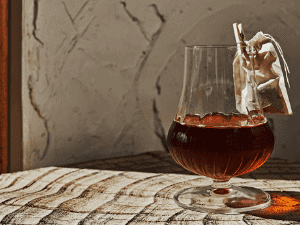 Mitra’s Tea Time, made with Persion tea-infused rum, Hennessy, Amaretto, apricot and Earl Gray tea, is served at Delbar in Atlanta’s Inman Park neighborhood. Photo by Andrew Thomas Lee.
Delbar offers Persian Tea on its non-alcoholic menu, which is an exciting blend of dark grey and Ceylon tea with a little bit of cardamom. “Traditionally Persian tea is served with two tea pots: one with strong tea and another with very hot water,” he says. “This way each drinker can adjust how strong they want their tea.”
Tea is also served with sugar cubes. “Instead of putting the cube in the tea, the drinker will usually put the cube in their mouth and drink the tea,” he adds, “and the sugar cube will gradually blend and melt in the mouth as the drinker enjoys their tea.”
Francis also told me that with Delbar being a Middle Eastern restaurant, they have many guests who do not drink alcohol for religious reasons. Being able to offer interesting non-alcoholic beverages like this, and zero-proof cocktails potentially with tea as a flavor base, “allows the night to go on a little more and allows people with aversion to alcohol to join the party without the risk of someone judging them.”
Clarke Anderson, beverage manager for Rocket Farm Restaurants, has a different application for tea at the table that is also intriguing from an operations standpoint. His company (which happens to be the same company I work for) uses a strategy called server empowerment. The idea is that the restaurant prepares items each day that the service team can grab and use at their discretion to delight guests for a special occasion or use to potentially avoid recovery situations, like long ticket times, long waits at the door or service missteps.
Clarke says that at Buckhead’s King + Duke, he uses something called a Tiny Toddy for this purpose. “We use a tableside pour into petite teacups to serve a delicious Pu’er Toddy.” Pu’er (sometimes spelled Pu-erh) is a type of fermented tea from the Yunnan Province of China. “This is a surprise intermezzo that tells a great story and engages guests with not only the tableside service elements, but also the source of the tea and the honey used in making the toddy,” Clarke explains.
“The idea is to use this small item to delight the guest, tell a wonderful story and ultimately avoid any recovery situations. These can make a big impact. Timing is everything, and when well-timed they can really wow a guest and save the day before they even know anything has gone wrong.”
Tea And Spirits
Of course, no beverage story would be complete without exploring how we can bring alcohol into the mix. I personally have worked with tea for years in cocktail applications, starting with the signature cocktail I created for the now-closed JCT. Kitchen over a decade ago and continuing through to the Chai Tai tiki cocktail that won me an exciting trip to New York for a roof-top bartender competition. (Click here to get the recipes).
There is a rich history of using tea in cocktails in America. Historical classics like Chatham Artillery Punch, originating in Savannah sometime around 1792, contained black tea along with brandy, bourbon, rum, sparkling wine and lemon. Modern classic examples include Audrey Saunders’ Earl Grey MarTEAni from New York’s Pegu Club, a blend of Earl Grey-infused Tanqueray gin, lemon, sugar and an egg white.
I was curious how my peers use spirits with tea, as there is so much nuance to how tea behaves in the brewing process. I think using it as the water element in cocktails is fantastic, as you can not only dilute a drink appropriately but also add so much flavor at the same time.
Francis says that he loves to use tea in frozen cocktails, which require a fair amount of water in order for the alcohol to freeze to the right texture. “It is a great way to add tons of flavor without adding any unneeded sugar that will affect the texture of the frozen drink,” he says.
Infusing spirits with tea can be slightly trickier, as alcohol extracts at a much higher rate than water does. Tea can easily turn bitter when over-steeped in water. How to handle that delicate balance in a spirits infusion?
“My tip is starting with a low amount of tea and constantly tasting every 10 minutes,” Francis says, “always checking for extraction and tannin level.”
Clarke agrees with Francis about infusions. “We taste the infusion often, every minute until we get the flavors we want without over extracting.”
Clarke describes the process he used for a popular cocktail at King + Duke called Leatherman (see sidebar). “It is a tequila negroni riff with reposado tequila infused with ripe Pu’er tea. We wanted to avoid the astringent parts of the fermented tea, so we did a short wash steep with hot water then a 10-minute first steep at room temp and a 15-minute second steep into a fresh batch also at room temp. We then blend those two together to get all the leathery, woodsy flavors out of the tea cake.”
Tea can get complicated, but it can also be a super-easy way to kick up the already abundant flavors of something like vermouth. “We use Dolin Dry with a chamomile infusion that sits for just 20 minutes at room temperature (24g/ 750ml),” Clarke says. “We don’t want too many earthy/swampy flavors, so we do a quick infusion to capture the high floral tones.” The vermouth is then used in a cocktail called Behind the Sun at St. Cecilia in Buckhead.
Exploring all that tea has to offer, both as a non-alcoholic option and as a cocktail game-changer, is well worth the effort for Georgia restaurant operators. Given that tea has been a dominant force in American drinking culture since before there was an America (Boston Tea Party anyone?), this “trend” is unlikely to disappear anytime soon.
 Lara Creasy is Beverage Director for Rocket Farm Restaurants, overseeing eight Superica locations in four states. She loves all things beverage from tea to tequila, coffee to cocktails, whiskey to wine, and gets to make a living at it.



