By Nancy Wood
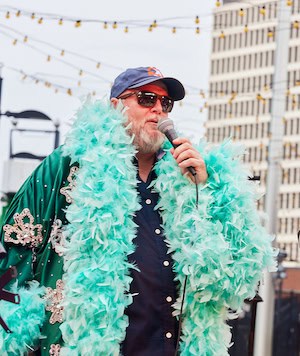 Unsukay Restaurants partner Chris Hall at Giving Kitchen’s 2024 Team Hidi Event
Giving back has always been a hallmark of the restaurant industry, and it’s virtually impossible to think of another type of business that gets asked for donations more – and more often.
And today, there are more opportunities to give back that you can count. A donation could be as small as a gift card or as complicated as staging a large event or curating an extravagant dinner party as part of a fundraising auction.
So how do restaurateurs decide which groups to support and how to do that? The reasons are as varied as the restaurants themselves – from choosing organizations that align with their mission to charities that will resonate with their customers or a non-profit that reflects a meaningful personal connection.
But whether the restaurant is small, multi-location or a company with multiple concepts, there is one common denominator: in this industry, giving back is an integral part of supporting the people and communities that support them.
Building Relationships
Making decisions about how much to give and which organizations to support primarily starts with planning and budgeting. Many restaurateurs have longstanding relationships with one or two groups, so their support has a greater impact.
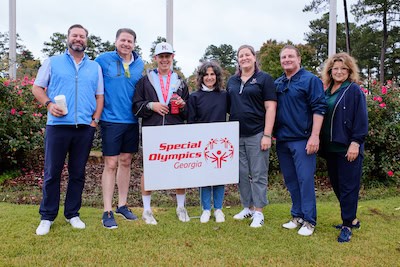 Marlow’s Tavern and Sterling Culinary supporting Special Olympics Georgia.
For Sterling Culinary Management and Marlow’s Tavern, run by CEO John Metz, philanthropy focuses on kids. While there are a lot of fundraising events at the local level, at its 18 Marlow’s locations in Georgia and Florida, “There are a couple of major causes that we’ve supported for many years,” says vice president of marketing and administrative officer, Kaffee Hopkins, “Special Olympics Georgia and No Kid Hungry.”
In fact, this year marks the 26th annual golf tournament to support Special Olympics Georgia. “It’s been a longstanding relationship,” she adds, “and it’s so nice to really have an impact on one special group.” During the day of the tournament, Sterling Culinary serves breakfast with Marlow’s burgers and chicken sandwiches for lunch. Afterwards there is a reception and silent auction.
“We have some employees and managers who have special needs kids who volunteer for the golf tournament,” says Hopkins, “and some of the Special Olympics athletes come.”
The company also donates a percentage of sales from every pre-opening party for a new location to the organization. To date, Marlow’s Tavern and Sterling Culinary Management have donated $1.8 million, making them one of Special Olympics Georgia’s largest donors.
Supporting children’s causes as well as health and wellness is a recurring theme among many restaurants. Veteran restaurateur George McKerrow, CEO of Ted’s Montana Grill, has focused primarily on childhood issues starting with the March of Dimes in the 1980s. And his philosophy centers on feeding young children’s minds, bodies and souls as the foundation to good health.
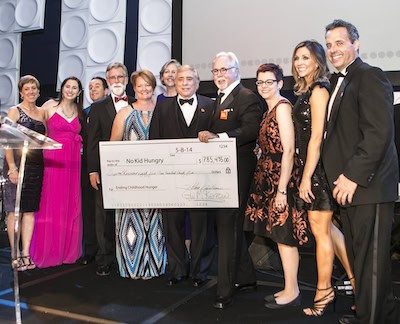 George McKerrow holding the check at Taste of the Nation fundraiser for No Kid Hungry
“My early philosophy, and it’s still here today, is healthy babies make healthy adults, and healthy adults make a healthy world,” he says. In addition to supporting No Kid Hungry, McKerrow currently serves as co-chair of the Captain Planet Foundation, which was founded by his business partner Ted Turner – “one of the greatest philanthropists ever.”
“We work with youth around the world to get them involved in their community to protect their environments and give them a voice about the future,” he explains.
One of the Foundation’s programs, Project Learning Garden™, provides schools with the essential elements to establish and support their garden-based learning programs.
“We’ve got over 700 active gardens, and 200 are here in Georgia where we teach youth about gardening and vegetables,” he says. “At the same time, we have a cooking and education program that dovetails out of that. So it’s more than just putting some seeds in the ground and tending to a garden.”
In addition to his work with Captain Planet, more recently McKerrow has focused on supporting restaurant workers and their families either through global non-profit CORE (Community Organized Relief Effort) or Giving Kitchen. “I see that as a big undertaking in the future for me,” he adds.
For Chris Hall, chef and partner in Unsukay, with Ryan Turner and Todd Mussman, giving back to the community is an important part of what his team does. When Hall joined Mussman and Turner in 2008, “I think we knew that being community centered and part of where we lived was important.”
The group, which includes Muss & Turner’s, Eleanor’s, Local Three, Mth Pizza and Roshambo, supports a plethora of causes, but their main focus is Giving Kitchen, the non-profit the trio helped to create to support foodservice workers facing crisis. Started as a fundraising effort in 2013 to pay the medical bills for their chef and friend Ryan Hidinger, who was battling cancer, the organization has since expanded and is now helping people across the nation.
“Every day we’re helping people,” says Hall. “I think we gave away $174,000 in July. Then there were 448 people in the Stability Network, and we referred them to 2,800 different services for assistance.”
As driving forces behind fundraising efforts, Hall and his partners are deeply involved in Team Hidi, the annual auction to benefit Giving Kitchen, and Dining with Gratitude, where restaurants designate a portion of proceeds to the non-profit from a special menu item during October. Supporting charitable causes is “just a natural part of who we are,” says Hall, “and it took on a new level of passion with the Giving Kitchen. That’s really become our most mission-centric charity because frankly, that’s our legacy.”
Giving to Grow: A Different Approach
While many chefs and owners start out with the idea of giving back, they may decide that it’s impossible until they reach some level of financial success. For Chris Smith, owner of Savannah-based Zunzi’s and Zunzibar, his philanthropic philosophy is an integral part of his management plan – part of the company’s DNA, as he says.
“I believe the key to growth is ‘give to grow,’” says Smith. “If you wait to grow to give, you may not ever grow. There’s a giving heart and then there’s financial P&L accountability. As a company,” he says, “we want to have a giving heart.”
With four locations in Georgia, and franchises opening in South Florida, the Villages, Tampa and Sarasota, Smith is determined to shake up the industry with an embedded methodology of giving back that includes each of his core stakeholders.
Once a quarter, each location holds Zunzifest, “a celebration of growth by giving and talking about why we’re in business,” as Smith describes it. For example, 1% of all sales from March, June, September and December are designated for a certain non-profit. On the second Tuesday of the following month, the money is donated to the non-profit. “We partner with a nonprofit that ties to our mission – to inspire you to live your dream,” says Smith. “We cross promote it the whole month to drive as much new business and as much awareness for them as possible.”
During the quarterly event, he explains, “We close at three o’clock and give out awards to our team and managers, and talk about next quarter’s initiatives and our exciting growth.” In addition, fans who are members of the 26 Club, their relationship-building program, get a free sandwich. At the Savannah location alone, Smith says, “we normally have a thousand people line up.”
Smith also sees this approach as a way to build relationships with his other stakeholders. “We want our franchisees to be able to celebrate, as well as our partners in the community and our vendors. It’s a way for them to celebrate their alignment with the company and celebrate their growth with giving as well.” The Zunzifest concept is also a part of his franchise agreement.
In planning his giving each year, Smith focuses on building long-lasting relationships. One group he raises funds for annually is Marine Reach Global, an organization that provides medical care, construction projects, supply distribution, and community and educational outreach to overseas communities in need. “One of our initiatives is to open in the islands, so we want to be able to support the islands in regards to medical missions.”
“Feeding America is another big partner of ours,” he says. Other recipients of Smith’s quarterly fundraisers focus on local organizations. Over the years that’s included a wide range of non-profits – from the Atlanta Community Food Bank to United Way of the Coastal Empire. “The whole premise is to be a good steward of what you’ve been given, and then you’ll get more.”
Finding Ways to Meet the Need
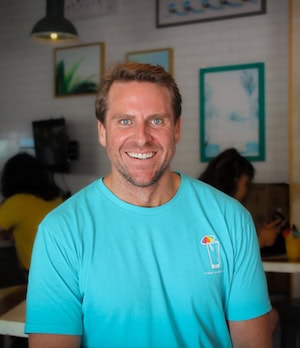 Chris Smith, owner of Zunzi’s and Zunzibar
While many restaurateurs and chefs often sponsor events and participate in major fundraisers for larger non-profits, supporting local non-profits is still a core part of the industry’s philanthropic giving. That local support runs the gamut – from gift cards and swag to food donations and participating in packages for raffles or auctions.
Although Giving Kitchen is Unsukay’s main focus, other non-profits still reap the rewards from the company’s largesse. Chris Hall says the team and management staff meet at the start of each year, and the events they sponsor or donate to are included in the budget as a line item. “We often exceed it,” he laughs.
While there are certain events they do each year, the company also has a reserve fund for pop-up events. And like most restaurants, it uses a website donation form to track the organization’s request and their donations. “Using the website is an easy tool for us to track who we’ve donated to in the past,” says Hall. “We try and spread it around because we can’t do everything we want to do.”
Hall also considers charities suggested by team members. “We never make the decision based on ROI,” he says. “We base it on the charity, if it’s important to us, and if it’s part of our community.”
Another consideration in making donations is increasing awareness and contributing to the overall marketing plan. For instance, the Unsukay partners always participate in the Southern Chefs Potluck, an annual fundraiser for Wholesome Wave Georgia, and are frequent participants in providing packages like dinners for 10 or a Chef’s Table as part of auctions. Hall says those are one of the company’s greatest marketing tools because “we’ve basically got a captive audience for several hours,” he says. “It’s a way to expose people to the things we do and give the best experience we can. I would rather give you an experience as opposed to a $50 gift card.”
For larger organizations that have multiple fundraisers annually, Hall works with that particular non-profit to streamline the ‘ask,’ so the donation has a bigger impact. For example, a nearby school may ask for a donation for multiple classes or a team. His solution is to offer one donation to the school and have their development team and/or parents figure what they want to do.
Geography plays a role as well. To that end, he adds, “We try and keep it geographically significant and support people and causes that we feel are really important to us,” says Hall. “It tends to be around people, kids, education, and health and wellness, obviously causes that are important to restaurants.”
Geography also plays a role in decision-making for Marlow’s Tavern. “We’re a neighborhood gathering place,” says Hopkins. “Our community supports us, and we feel like we should reciprocate and support our neighborhoods, our community, our city and our suburbs.”
One way Marlow’s supports individual communities is through ‘Spirit Night’ for local high schools, middle schools and grade schools. “We like to support the sports that don’t get the funding that some of the big sporting groups do.” The local Marlow’s Tavern promotes the designated night with signs at the school and donates 15% of sales to the school group. “It’s a really good way for each tavern to do something for their neighborhood,” she says.
Ways to Give Back
For any restaurant, giving back doesn’t always mean going big. Participating in existing fundraisers is an easy way to get involved. No Kid Hungry, for example, holds a fundraising promotion every October, where proceeds from a special menu item are donated to the organization. For that particular fundraiser, the restaurants run by Sterling Culinary Management also reward their guests for their generosity. “We ask our guests one time a year for a month,” says Hopkins, and if you give, you get $5 off the next month or quarter when you come back.”
Rounding up guest checks for a certain non-profit for a specific amount of time is another tried-and-true method of giving back, and collaborating with other restaurants to create a curated experience can be a real boost for awareness. Gift cards and other promotional items are also a cost-effective way to reach an audience and can often be included with other organization’s donations to make a bigger impact on a non-profit’s bottom line.
“From a giving standpoint,” says Zunzi owner Chris Smith, “we partner with local nonprofits all the time. We donate and discount food orders, and we have a program for smaller local non-profits and give them a gift card, four bottles of sauce and T-shirts. We’re always engaging.”
When it comes to donations, “one size does not fit all,” says Hopkins, “If it’s something big and there’s a lot of exposure, that’s when we do a really cool experience like a dinner for eight in someone’s home. But we never say no to an auction or a golf tournament or whatever it happens to be, because we can give gift cards to all of those things.” And, she adds, “You don’t have to always give money.”
“When a lot of people think of philanthropy and charity,” says Hall, “they think of money, but time and talent is also incredibly important. You might not have a ton of money, but you have talents that other people don’t have.”
With seemingly endless opportunities to give back, George McKerrow offers some sage advice. Whether it’s a big company or an individual, “It’s having a mindset that you want to get involved in the community,” he says, “and you want to get involved in giving back and sharing.”
He encourages restaurateurs to focus on one area and not give randomly to any and all groups. “Whenever a company has a singular focus and everyone is working towards that mission,” McKerrow says, “it helps bring people together and motivates a team to create a sense of purpose and a culture of community. Nowadays more than ever, community counts.”
Here’s a list of select charitable organizations to consider for giving back.



