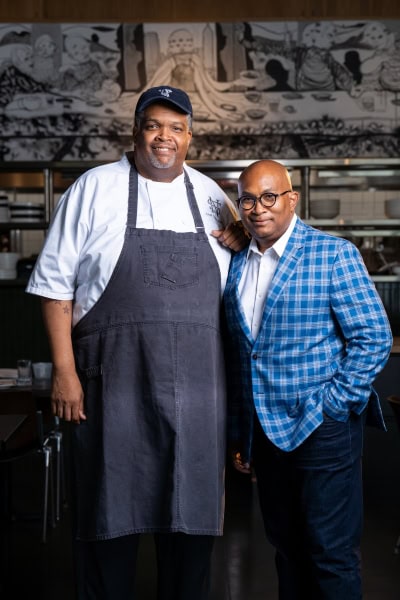
 Duane Nutter and Reginald Washington
At airport security, a chef sets down a ten-pound bag of locally-made sausage on the TSA conveyor belt.
“I got it from a guy at the farmers market. I wanted to run a special,” recalls Chef Duane Nutter, former executive chef of One Flew South at Atlanta’s Hartsfield-Jackson International Airport. “The first few times I did it, the agents were confused.”
This story represents what airport restaurant operators navigate daily. Behind each menu item are complex regulations surrounding everything from TSA clearance to delivery schedules, from compliance checklists to staff security protocols—things that street-side operators never face.
“Something that makes our industry so challenging is the regulatory environment and keeping up with requirements that differ in every airport,” says Daniel Halpern, President and CEO of Jackmont Hospitality, owners of One Flew South and other airport concessions. He says that companies operating in multiple airports must build customized compliance systems for each location.
“Running an airport restaurant is a completely unique world,” says Wael El Tabech, Regional Director of Operations for Paradies Lagardère. “Everything is more regulated. Every team member has to pass background checks and go through the badging process, and even delivery vendors are screened by TSA,” he explains. Security clearances impact an airport restaurant’s hiring timeline and seriously affect how operators must plan recruitment.
Even routine kitchen operations face scrutiny. “All knives and tools have to be tethered and counted twice a day, and TSA reviews those records,” says El Tabech. Nutter explains that knife inspections happen every few months, layered on top of standard health checks.
 Daniel Halpern
Supply Chain and Logistics
Logistics make or break airport operations. “Deliveries usually happen overnight between 11 p.m. and 5 a.m. when the terminals are quieter,” says El Tabech. “That narrow window demands precise coordination.”
Halpern explains that some airports require suppliers to drop products at a warehouse, where a third-party company distributes them inside the terminal. Others allow direct vendor access. Either way, he says, “You’re managing security, timing and freshness simultaneously.”
Due to tight regulations, many specialty products from smaller producers are often delivered via FedEx and UPS.
Limited storage means efficiency must be engineered into menu design. “We plan our menus around ingredients we know we’ll always have,” says El Tabech. “That helps us maintain quality and consistency no matter what.”
 Wael El Tabech
Margins Under Pressure
Before a restaurant can even get to the point of managing deliveries, they must jump through the hoops of getting open. “Construction costs can exceed $2,000 per square foot, roughly three times the street-side average,” Halpern explains. “Percentage rents often run in the mid-to-high teens, compared to typical 7 percent targets.”
Multiple factors influence airport restaurant construction costs, such as strict security requirements that add to administrative expenses. Construction must often take place during off-peak hours to avoid disrupting airport operations, which can result in overtime wages and longer project timelines.
The way guests dine at the airport also requires making unique decisions about presentation. Grab-and-go meals are a staple for airport travelers. Operators must choose the right container to ensure consistent portioning, speed and visual appeal. To keep his standards consistent, Nutter uses a detailed “Look Book” with photos and instructions that help ensure every team member understands how to present each item.
Technological Solutions
Technology can help streamline airport operations, but operators must maintain perspective on its role. “Digital tools have made the whole experience more efficient and personalized,” says El Tabech, “but at the end of the day, hospitality is still about people.”
“There really has not been any kind of a definitive application for technology on the sales side in an airport,” Halpern adds. He says some airports have their own apps for ordering food, but there certainly is not a one-size fits all solution yet.
He envisions digital convenience existing someday that could allow travelers to place an order from any airport within a single app. “A one-size-fits-all for special venues. It could be for stadiums, it could be for airports,” he explains. “That could be helpful, but then you’ve got to get everybody to agree to a single solution, and that’s easier said than done,” he says. “McDonald’s, Starbucks and TGI Fridays have their own app. So I think it’s still too soon to see if there’s going to be any sort of adoption to a single platform.”
Currently there are a few digital airport-ordering apps. OTG Management, an airport hospitality group and technology company, is rolling out a mobile app in selected airports, allowing travelers to order food for gate delivery up to 24-hours in advance. Other third-party applications for mobile and web-based airport restaurant ordering include Grab from Servy and At YOUR Gate.
Why It’s Worth It
Given the red tape, night shifts and slim margins, why do seasoned operators keep bidding for airport locations? Despite the challenges, the airport dining sector continues to grow.
For Nutter, it’s about purpose as much as profit. “Bringing a concept into the airport adds to the sense of place of the city it’s in,” he says. “It creates a great value and experience for the traveler and quality jobs for the people who live in the city.”
Halpern agrees. “We’re ambassadors for our communities. Every time a traveler eats with us, they’re getting a first or last impression of that city.”
According to DataIntelo’s Airport Food and Beverage Market Research Report, the market reached $22.7 billion in 2024 and is projected to reach $42.3 billion by 2033. Rising passenger traffic and demand for premium, chef-driven concepts are driving that growth.
Nutter, Halpern and El Tabech all emphasize that airport dining may be one of the toughest gigs in foodservice, but it’s also one of the most forward-looking. It is where logistics meet hospitality, and where innovation is born from necessity.
“Business travelers actually plan their layovers so they can go to One Flew South,” says Nutter. The restaurant, twice nominated for a James Beard Award, helped redefine airport dining.
That distinction captures what defines airport hospitality at its best: service built on empathy, consistency and pride in representing a brand and a city to the world.
 Toby Bloomberg has been called a social media “OG.” Her adventures in food social media began in 2006 with the launch of the first culinary character blog for Gourmet Station. She was part of the team that launched Chick-fil-A’s first listening strategy and has worked with chefs, restaurants and craft “foodpreneurs.” She believes a brand’s most effective way to build and nurture relationships is through strategic digital storytelling. Bloomberg is a member of Les Dames d’Escoffier International’s Atlanta chapter.



