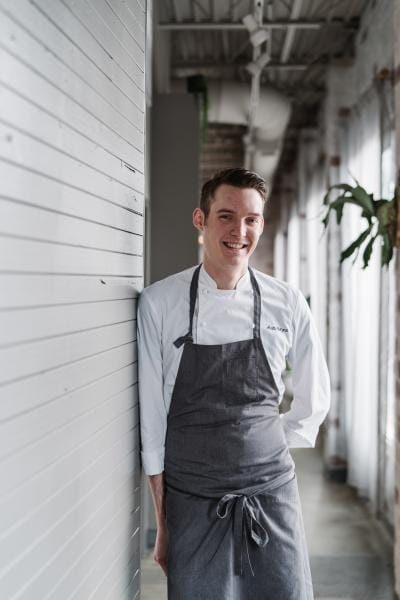
Before he ever touched a knife, Executive Chef Austin Goetzman stood at a sink. He was a dishwasher, watching the line, and what he saw changed the direction of his life. The heat, the noise, the controlled chaos of a kitchen mid-service. It did not intimidate him. It gave him a sense of direction.
“It was very sports like; it’s competitive,” Goetzman recalls. “When service happens … you have this rush performance adrenaline. It’s like putting on a show.”
Goetzman followed the heat. Over time, that early fascination sharpened into something more intentional. As an executive chef, he understands that a restaurant is not really built on food alone. It is built on the people who make it.
Goetzman’s path into food began in small-town Alabama, where his grandparents’ home cooking gave him an early view of food made with love and care. Alton Brown’s TV series “Good Eats” later sparked his interest in the science behind cooking. He carried that curiosity to culinary school in Atlanta and eventually California working at The French Laundry, the three-Michelin-starred restaurant founded by Thomas Keller.
“It was amazing, very disciplined,” he said of The French Laundry. “It definitely changes you as a cook. It sets you on a path, if this is something you want to do as a career.”
Ask Goetzman what makes a great kitchen culture, and he will not start with technique. He will start with people. “It’s a people business, because restaurants don’t function without people,” he said. “Restaurants may serve food, but they run on people.”
In his view the culture of hospitality must be integrated into all aspects of the restaurant. It shows up in how the front-of-house team treats guests, how cooks respond to the rush and how leaders handle pressure. “100% always hospitable, from being hospitable to your cooks, to your employees,” he says. “A supported team performs better, and guests feel the difference.”
That philosophy shapes how Goetzman thinks about mentorship. He worries that real teaching has slipped in too many kitchens, replaced by recipes, numbers and the pressure to simply get through service.
Technique matters, but he sees leadership development as the harder and more important work. “You’re only as strong as your weakest link, and it’s your job to make sure that that link is nurtured,” he says. “I can teach you how to cook a turnip. That’s easy. But teaching how to lead… that’s a whole other ball game.”
Goetzman is realistic about the business. Passion alone will not bring repeat customers. Talent and hospitality working in tandem create consistency, and consistency leads to a booked-out restaurant. His definition of success is not built around a single name on the door. “Success for me is a happy team,” he says. “A team that can perform. People that are learning.”
For Goetzman, the dream is not one chef standing alone at the center of the room. It is a team that wants the work, understands the standard and grows together. “The team that you have behind you is one of the most important aspects of your direct success,” he says. “Your ability to mentor and teach that team is correlated to how successful you’re going to be. And when you have a team like that, there’s nothing you can’t do.”
Read More About the Other 2026 Rising Stars
Michaela Finlayson
Frank Fodor
Remy Loet
Sebastián Montero-Hernández
Alexandria Rogers
Richard Wilson
Thank you to our presenting sponsor, Georgia Natural Gas, and table sponsors, Society Insurance and Savannah Distributing, for making this event possible:
Presenting Sponsor

Table Sponsors
Savannah Distributing and Society Insurance



