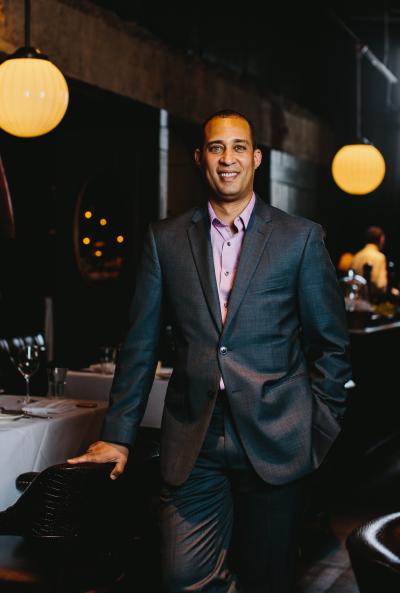
For our Special Technology Issue, Restaurant Informer caught up with Mac Angulo, Vice President for Rocket Farm Restaurants, to talk tech. Rocket Farm, which is based in Atlanta, has a total of 28 restaurants spread across five states, and hence a whole bunch of technological needs.
He’s seen the industry grow from planning reservations out with pen and paper to letting AI answer the phone so hosts don’t have to—quite an evolution. We asked Mac to get real with us about what restaurateurs really need from their technology and what they don’t.
Restaurant Informer: Hi Mac. Tell us a little bit about what you do for Rocket Farm Restaurants and how you came to assume that role.
Mac Angulo: I’m one of the Vice Presidents for the company, and I oversee our Superica restaurants. I started working with Rocket Farm Restaurants 13 years ago as the Assistant General Manager of JCT Kitchen & Bar. Shortly after starting, I was promoted to General Manager. I was tapped to open Marcel, a European-inspired Steakhouse, in 2015 until I was transferred to be the GM of The Optimist in 2017. By that November, I was promoted to Vice President. Over the years, my focus has shifted according to our current needs. Since 2022, I’ve worked with the Superica team to drive excellence in our operations.
RI: So as part of that job, we assume you are heavily involved in making decisions about technology platforms the company uses, yes?
Mac: That is correct. I’ve weighed in the decision-making process for several of our technology platforms and have been tasked with the rollout when it has a heavy focus on operations.
RI: Do you think that companies that design software for restaurants really understand the needs of restaurant operations? What are some examples you have found where they really did not get it? Or an example where you thought, “Wow, this will be a game changer for us!”?
Mac: I believe that the best software companies partner early with restaurants to understand their needs. There are times where we see software that has been designed for another field and they’ve attempted to adapt it to restaurants. Often, this results in a clunky setup that proves frustrating for our operators to use. One of the things that I’ve been most excited about has been the transition to handheld POS devices. We have seen so many options over the years, and it’s really only in the last 5 years that the technology has reached the point where it makes sense.
RI: What do you think is the most challenging part about choosing technology for multiple units? Any examples?
Mac: We are careful to always balance the needs of our different restaurants and the corporate office. Making sure that a solution that works for our corporate team also makes sense with the daily workflow of our managers and chefs is essential. Our teams already have so many different platforms they need to use to do their job. We want to make sure we are solving a problem and not adding complexity to their day. At one time we used four different systems to manage scheduling, timekeeping, payroll and our employee files. Selecting and migrating this to one system that was easy to use by our managers was a multi-year process.
RI: Are there ways in which you think technology has made your job as an executive easier? Certain types of reporting you were not formerly able to access, or efficiencies you have gained?
Mac: I started in restaurants when we were still manually writing our notes in a logbook and managing reservations with pen and paper. I now have real time access to sales, labor, cost of goods, manager notes, reservations, etc. Technology has helped save time and drive productivity in every part of our operation. One of the best improvements as an executive is how quickly I am able to access the financial performance of our restaurants. This allows us to quickly identify areas of focus and take corrective action.
RI: Do you use A.I. for anything in your restaurants? How do you think it will be most applicable for restaurants long term?
Mac: AI is such an exciting technology with a ton of potential. We use an AI agent to answer phone calls at all our restaurants. This helps make sure our guests are able to get the answers they need without having to sit on hold. We are just starting to look at ways that we can use AI to analyze feedback and financial trends. Personally, I’m a big fan of AI notetakers. Having a transcript and condensed summary of our meetings allows me to focus on the discussion instead of taking notes. I’m looking forward to seeing AI agents developed that will help guide our management teams to areas of focus in their operations.
RI: Any advice you can give to operators, either single unit or multi-unit, as they navigate the tech world?
Mac: While they may seem exciting, I prefer to wait to see how new technologies work when implanted. I’ve often found that the more mundane solutions are the ones that save the most time. Talking with our managers to hear their challenges and keeping in mind how our choices affect their workflow is essential.



