How food suppliers are shifting gears and helping their customers, grocery stores and others in need
By Christy Simo
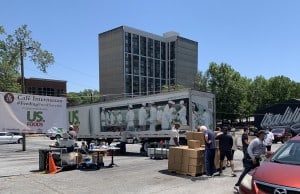 Cafe Intermezzo spearheaded a food drive for out-of-work restaurant workers in April
When William Pitts, CEO of Cafe Intermezzo in Atlanta, had to shut his restaurant’s doors in March, he knew he had to do something to help his employees and others in the industry who were suddenly left without money to buy food for their own tables. The restaurant also had a ton of product that would go to waste. So they got to work, and on March 18 and March 19, they gave out 4,000 meals to those in the restaurant industry who needed food.
“It was heartwarming and heartbreaking all at the same time,” Pitts recalls. “This was just days after the faucet of income had been shut off for most people. It just left us all thinking, wow, the need is this bad three days after everybody’s income has ended. What’s it going to be like in three weeks?”
That’s when US Foods got involved. Pitts contacted them along with several other companies it works with to see if they’d be interested in scaling up efforts to feed more people the next go around.
“The response was really incredible,” Pitts says. “Everybody immediately said, yes, let’s do it. We’re on board, let’s take care of these people.”
For the second food drive April 10-11, the team along with 120 volunteers spent three days in Midtown Atlanta packing up 50,000 pounds of product provided by US Foods into boxes with enough food for 10 meals per box. Nearly 2,400 boxes were distributed over two days.
“US Foods put a lot of effort into this. They probably put 20, 30, 40 hours of planning into this event,” Pitts says. “I expected one tractor trailer … but when the two 48-foot trailers showed up with food on a Thursday morning, they were loaded all the way from front to back with food.”
From Cafe Intermezzo’s efforts to #AtlFamilyMeals to Table & Aid in Roswell, wherever restaurants are pitching in to help others, the state’s foodservice suppliers are there alongside them donating food and financial support.
Lending Support
To date, US Foods has donated $2.5 million in food and supplies – more than 150 semi-truck loads of product – since mid March to fight hunger across the country during the COVID-19 pandemic. That product is going to longtime partners like Feeding America, but also to local initiatives like Pitts’ efforts and the Lee Initiative’s Restaurant Workers Relief Program, which is being administered locally by Linton and Gina Hopkins of Hopkins & Co.
US Foods is just one of many foodservice suppliers that have pivoted to help feed their own customers, many who have found themselves with doors closed and immediately out of work.
Sysco has also been busy helping numerous groups across Georgia and around the world.
On March 19, Sysco originally announced a goal to donate 2.5 million meals over the course of 4 weeks. Just over a month later, it announced it had donated more than 13.5 million meals across the globe.
 Sean Hyslop, president of Sysco Atlanta
Sysco Atlanta has been donating food to a number of local initiatives to feed out-of-work restaurant employees, including #ATLfamilymeal in intown Atlanta and Table & Aid in Roswell.
“ATLfamilymeal, those guys are doing a great job,” says Sean Hyslop, president of Sysco Atlanta. “They’re producing 8,000 to 10,000 meals a day, making sure that hospitality workers who are unemployed right now at least have meals.”
Table & Aid is another grassroots effort led by Ryan Pernice of RO Hospitality to serve out-of-work restaurant employees. The group is operating out of one of its restaurants, Table & Main, in the heart of Roswell. Meals are served Tuesday through Sunday from 12 noon to 4 p.m., and guests can request up to six meals to go.
While the original goal was to serve 50 meals a day when they launched in March, they’re now averaging 152 meals a day and have since served more than 2,750 people. Sysco, US Foods and Horizon Foods are helping the effort.
“We’ve been happy to support him and his endeavors and quite a few others,” Hyslop says. “It’s really been encouraging to me to see how the hospitality industry is just such a family, and even in rough times just like this, we’ve all banded together to help one another out.”
The company is also donating food and financial support to Meals on Wheels and the Atlanta Community Food Bank, two nonprofits that it already sponsors, along with Goodr, which is supporting programs to feed school-age kids who are missing meals now that schools are closed.
Being a Resource
Restaurants haven’t been the only ones struggling with this new dynamic we’re all living in. Grocery store shelves have been bare, in part due to logistics issues. Sysco has stepped in to provide logistics services and provide supplies to keep grocery store shelves stocked with the necessities.
“We’ve taken the capacity that we have here to help fill the supply lines by selling direct to those retail environments,” Hyslop says. Sysco is also helping support the grocery store supply chain both with its logistics services experience and by shifting some of its employees to their facilities. “For their distribution centers where their supply chain may be a little bit overwhelmed, we’re helping there,” he says. “Sometimes we’re even helping them with employees, making sure that they have enough manpower to help meet the demand that’s happening.”
And Sysco continues to be a resource for those in the restaurant community, providing information on how to pivot to takeout, how to turn your restaurant into a general store, and how to set up online ordering. It’s also been distributing cleaning supplies to keep restaurant kitchens safe and virus free.
“This is a path that quite honestly most of us haven’t had to travel, so we’re just trying to find as many ways as we can to be a valued resource to the customer right now,” Hyslop says.
While many restaurants are starting to get into a groove serving takeout and curbside delivery, the learning curve has been steep. To help restaurants pivot, food suppliers like Performance Foodservice and Sysco are providing a wealth of information.
“We’re very focused on helping our customers understand what the to-go world is and how to effectively manage that. Packaging of products, how they market it on social media, getting into the online ordering environment to make it easier for their customers to interact and place orders with the customer,” Hyslop says. “The more synergy that we can create there, the easier it is for the customer to interact with the restaurant, the better opportunity that their revenues grow.”
In fact, Sysco has established a section on its website dedicated to providing helpful information for restaurants in the age of COVID-19. The site features checklists to keep your facility, team members and guests safe; tools to help restaurants continue to develop takeout and curbside delivery options; how to ramp up online ordering; and how to develop “pop-up” general stores in your restaurants, among many other resources.
“We’re seeing some good success for restaurants that are effectively managing their to-go and these retail pop-up environments,” Hyslop says. “That ability to just go in on your phone and pick the menu items now, pay for it all in one seamless transaction, then just drive up to the restaurant and have them walk out and put the product in your car – that’s been very successful for restaurants. It creates a comfort level around social distancing.”
Sysco, like everyone else, is keeping one eye on the future and anticipating what will come next when business can return to a sense of normalcy again.
“Financially, we have a really clean balance sheet. We manage our assets pretty well,” Hyslop says. “It’ll be tough, but we’ll come out of it on the other side still in a very financially stable position and be ready to service our customers when we all hopefully see that snapback that happens when they lift the social distancing. We’re not really sure when that’s going to be or how robust that will be. But I am quite sure that we’ll be ready when that day comes.
“In meantime, we’re going to continue to put out more educational pieces that we can, and we’re going to continue to share stories about what we’re seeing in our customer base that’s helping drive success, helping drive revenue, get additional recommendations on best practices and just try to be everything we can from a resource perspective for our customers,” Hyslop says. “Our mindset is really honed in on everything that we can do to take care of them and make sure that they get through this in one piece.”
How to Help
There are so many groups helping feed out-of-work restaurant employees, and they need more restaurant partners, product and financial support. If you want to help, here’s how you can contact the initiatives mentioned in this article:
#ATLfamilymeal: Contact them via website to become a partner.
Cafe Intermezzo Food Drive: Contact Cafe Intermezzo President William Pitts directly to help sponsor the next food drive.
Restaurant Workers Relief Program: Spearheaded nationally by the Lee Initiative with the Atlanta outpost overseen by Linton and Gina Hopkins, the program offers food for out-of-work employees. Make a donation here (choose Atlanta from the drop-down menu to direct funds to Georgia), and learn more here.
Table & Aid: Food is distributed from Table & Main restaurant in Roswell. Donations (cash or checks made out to Table & Main) are accepted at Table & Main. You can also Venmo RO Hospitality Owner/Operator Ryan Pernice directly at “Ryan-Pernice” on the app. They are particularly in need of large, hinged “clam shell” to go containers, with or without dividers, to continue this effort.



