Luxury tequila sales surge despite, or maybe because of, the new COVID reality
Operating, as I have been, for the last year in a severely altered restaurant economy due to COVID, I would never have guessed that ultra-premium tequila is the fastest-growing spirits category in America. Don’t get me wrong, I don’t find the news completely unbelievable. Working as beverage director for a group of Tex Mex restaurants means I spend my days surrounded by tequila, and I have a pretty good idea about what brands sell and what guests are calling for.
But our entire industry has been suffering this past year. Sales are down in dining rooms overall, due to local government restrictions and the public’s general level of caution. So how, I had to find out, how do we find ourselves in the middle of a global pandemic and its subsequent economic downturn with a surge in luxury tequila sales?
I asked a few industry friends and acquaintances for their input on the matter.
Upping the Ante at Home
The downturn in on-premise restaurant sales due to COVID might actually be a factor that is driving the interest in high-end tequilas, according to Josh Dornellas, on-premise district manager for Empire Distributors in Georgia.
“People who are not buying on-premise are now spending their disposable income on drinking at home. It’s easy to go out and spend $150 on a nice bottle of tequila when you aren’t spending money out at a restaurant as regularly,” Dornellas says.
Guy Leone, national account manager for Brown-Foreman (owners of the Herradura tequila brand), agrees with this reasoning and takes it a step further. “I believe that this explosion was due to the popularity of the margarita in on-premise. Consumers could no longer enjoy the No. 1 cocktail in America at their favorite bar, so they opted to make their own at home. In doing so, I believe consumers traded up in quality and began purchasing ultra-premium tequila, as opposed to inferior-priced products.” Leone adds that consumers “were also able to explore the category for the first time at retail, as opposed to being more limited in choices on-premise.“
Guy could be on to something there. In our dining rooms at Superica, margaritas sell easily 3 to 5 times as much as the next best-selling alcoholic beverage, even during COVID. Over the last six months, I’ve started noticing guests are upgrading their tequila in our classic margarita, and Casamigos has become a very popular call for that.
Owned by George Clooney and Randy Gerber, the Casamigos brand was founded in 2013 and slowly built to become the No. 1 fastest-growing spirits brand in America. Casamigos was originally intended to be a private tequila for its celebrity owners to consume, but it eventually became a brand that the multi-national spirits portfolio Diageo found valuable enough to option for $600 million in 2017.
Speaking about Casamigos, Empire Distributing’s Dornellas told me that he’s been with Empire for 6 years. “When I started with the company, I couldn’t give it away! Selling on the celebrity angle wasn’t effective,” he says. “I mentioned George Clooney. We mentioned George Clooney and people didn’t care.” But slowly, over time, he said, people became more comfortable stepping up to the next price point for tequila. Now, 5 years later, sales of Casamigos are growing like crazy, up 170% in 2020 over 2019.
“During an economic depression, people trend down, but we are not seeing that right now. Premium tequila is out of control right now. I have places [in my territory] that charge $16 for a Casamigos cocktail, and they are still going through 3 or 4 cases a week,” Josh says.
If the celebrity angle didn’t work, then what did? “As far as flavor profile, Casamigos trends on the sweeter side,” Josh says. “People talk dry and drink sweet. The quality is there, but people took some time to catch on.“
Innovation Leads the Surge
Tequila as a spirit, in general, is in double-digit growth right now. Maybe it’s because of the flood of tequila references in popular culture, including mentions in songs and display in music videos. Maybe it’s because of the explosion of celebrities that own or endorse tequila brands, everyone from The Rock (Teremana) to Justin Timberlake (901) to George Strait (Codigo). Or maybe it’s because everyone has finally caught on to how generally awesome tequila is (not that I’m biased).
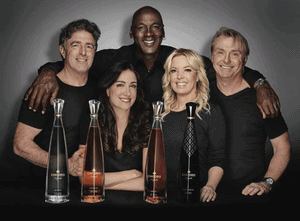 Cincoro tequila was founded by five NBA franchise owners, including basketball legend and Charlotte Hornets owner Michael Jordan (center)
The market has expanded its offerings to meet this increased demand. Adam Rogers, research director for North America at IWSR, a widely used source for alcoholic beverage trends, wrote that “100% blue agave products have exploded as the dominant product consumers seek. Tequila production is regulated, however, so there are limitations. Most brands have focused on developing higher-quality products as well as unique elements in finishing or aging.”
Some examples of innovative tequila products making waves in the market include the “cristalino” process, in which aged tequilas are filtered to remove all color from the barrel influence (products such as Herradura Ultra, Casa Dragones, and Dobel Extra Añejo Cristalino); extra age statements beyond añejo or extra añejo (products such as Don Julio 1942 and Herradura Seleccion Suprema), single-barrel offerings (such as Herradura’s Double Barrel Reposado), 100% organic offerings (such as the 1, 2, 3 Tequila line), single-estate products (such as Ocho) and 110-proof offerings (such as Herradura Director 110 proof).
Often packaged in exquisite bottles and priced to reflect their exclusive nature, these tequilas are certainly capitalizing on the “moment” that tequila as a category is having.
A Love for Luxury
Another prime example would be Cincoro, a brand introduced in September 2019 to a willing consumer audience. Founded by five owners of NBA franchises, including Michael Jordan, the name is an appropriate amalgam of “cinco” and “oro,” meaning five and gold.
The brand started with the owners’ love for luxury tequila brands such as Clase Azul. Michael Jordan loved Clase Azul so much, he had tried to buy the brand outright, but the owners told him no, according to Lindsay Wagner, Georgia state market manager for Cincoro. Instead, she told me, he and his co-founders developed a partnership with master distiller Augustin Sanchez, former distiller of Patron Platinum, and started their own luxury brand.
While working on the blend for the tequila, Cincoro co-founder Emilia Fazzalari (owner of the Boston Celtics) asked Augustin why tequila brands never blended Highland and Lowland agave. He essentially told her they just don’t, according to Lindsay, and her answer was, “Well, why not?” The group decided to try it, hoping to get the best of the fruitiness of highland terroir and the best of the earthiness of the lowland terroir.
As they continued to innovate with their brand beyond just the blend of agaves, Augustin also decided to blend roasting styles, employing both a traditional clay oven and a modern autoclave, using both techniques on both types of agave. The result is a tequila made from four different roasts with four totally different flavor profiles, which are blended together to get the desired combination. Add to that a proprietary yeast strain, distillation in alembic stills with copper coils, and aging in used Tennessee whiskey barrels, and you have quite a bespoke tequila brand!
The bottle for the brand was designed by Mark Smith, the designer who worked in the past with Michael Jordan on his iconic Nike Air Jordans athletic shoes. A number of thoughtful touches on the Cincoro bottle add to the brand’s mystique: the bottle itself is shaped like an agave leaf; 23 (MJ’s number) of the bottles laid end to end equal the length of a basketball court; the agave on the label has five leaves for the five owners.
The brand was launched with not just a blanco and a reposado, as many new tequila brands are, but also with an añejo, aged for 24-28 months, and an extra añejo, aged for 40-48 months.
It’s very unusual for a new spirits brand to launch with such aged expressions, and Lindsay agrees. “The owners have been working on this for over five years,” she says. “Even though it went to market in 2019, it took a long time to get to that point.”
Another Boom and Bust?
Other spirits categories that have seen a surge in popularity over the past few years, such as rare bourbons, eventually suffered from a demand that far outpaced supply. I wondered while talking to Josh if some of those frustrated drinkers were perhaps defecting to other premium spirits like tequila. He and I agreed that it’s probable that the allocation of rare whiskeys and the demise of premium vodka as a trend must have sent devotees looking elsewhere.
 Mark Smith, who designed the iconic Nike Air Jordans, created the Cincoro bottle design
Unlike bourbon, tequila sees most of its aging on the front end of production, in the field, where agave plants take 6-10 years to fully mature. Once those agaves are harvested, a blanco tequila (the most popular style according to Nielsen sales figures) can be to market in less than a year. “Access to luxury and premium brands is much easier,” Josh says.
However, Guy points out that pressure on agave supplies and prices could impact tequila’s growth trajectory. The cyclical “boom and bust” of agave pricing and supply that we have seen in recent years is likely to continue due to the free market conditions with agave farming. Farmers can’t produce agave on a whim, and commitments to farms are often decided based upon futures pricing, with a torturously long 6- to 8-year cycle. Could our current appetite for premium tequila hit a wall in a few years when agave supply hits another bust cycle?
Guy points out that unlike the beer brewing industry in Mexico, which shuttered production during part of the pandemic, agave farmers continued farming, reducing the pressure on supplies. “Keep in mind,” he adds, “Herradura has 200,000 acres of estate-grown Blue Weber agave.“
Because we are talking about supply and demand, Josh tells me, you can set a price that people are willing to pay, and if they are willing to pay it, they’re willing to pay it. That’s how it goes with super-premium goods. And that may well be how it goes with ultra-premium tequila, regardless of supply over the next few years.
Right now, retail is reaping most of the benefit of consumers upgrading to these premium products. But the on-premise luxury tequila boom isn’t far behind. Guy, looking ahead to a post-COVID world, expects there to be more on-premise ultra-premium tequila cocktails on restaurant menus than ever before. This tequila-loving mixologist would be perfectly happy to see that come true.

Lara Creasy is Beverage Director for Rocket Farm Restaurants, overseeing 8 Superica locations in 4 states. She loves tequila so much that she has made multiple pilgrimages to Mexico to witness the magic of agave distillation.
Read More From Lara Creasy
It’s Time to Take Your Team’s Temperature
Everything’s Coming up Rosés: Learning to Love and Sell the Pink Stuff



