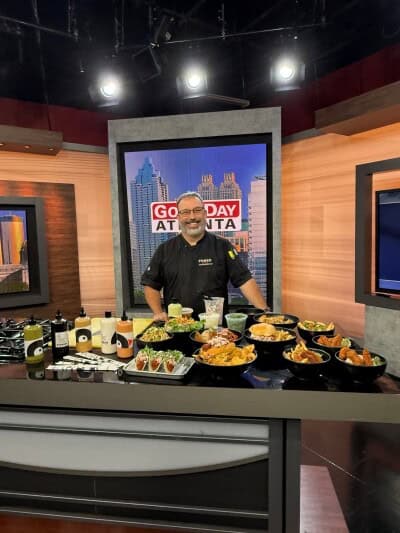
 TV time moves fast. Bring dishes in various states of preparation to keep the segment moving.
With the rise of celebrity chef culture, many kitchen talents have made the move from back-of-house to center stage. Cooking demos on the morning news, talk show segments and televised community events can all offer a route to household name recognition. But how do you begin? And how do you make sure you nail it when you get the opportunity?
Get Involved with Your Community
“There are a number of ways to become noticed by local media,” says Debbie Rosen, president of public relations agency The Rosen Group Atlanta. One that Rosen recommends to chefs or restaurateurs is hosting an event to benefit a favorite non-profit.
Robert Butts, executive chef and co-owner of Auburn Angel and a frequent festival contributor, suggests, “Local news outlets are always looking for something new to showcase, and they typically need someone to represent and talk about the events going on.” He says that sometimes being present at a charity event and letting organizers and reporters know that you’re available for a sound bite before or during the festivities is all it takes. An interview provides a great opening to talk not only about your place at the occasion, but also to tell the story of your restaurant and “why it’s a place viewers should try,” as he puts it.
After all, as Liv Hurst, executive chef at Cattle Shed Wine & Steak Bar says, “People can feel when you’re passionate about what you do. When you’re genuinely proud of your craft and community, that energy naturally attracts attention from local media and beyond.”
Pitch – and Speak – Mindfully
When pitching segment ideas or appearances to local media, it’s important to be “timely and topical,” says Rosen, but remember that you don’t have to put all your cards on the table. Rather, deliver what the reporter or host needs.
“First, watch the show you want to be on,” Caren West, president of Caren West PR, LLC, advises. “Get to know it, what they’re covering and how, who their audience is. What’s their vibe? Understand their cadence, the types of segments they run, and how your story could complement what they’re already doing,”
From there, trust that you’ll have other chances to show off. By prioritizing their coverage focuses, you’ll build a relationship that will create prospects.
This has worked for Hurst. “The more approachable and reliable you are, the more likely they’ll call you back. That’s how I built long-term relationships with local media before opportunities like Chopped came along.”
“The segment can’t just be a plug for the thing you are wanting to promote. You need to make it fun and entertaining in addition to getting your message across,” Taryn Scher, The Sparkle Boss for TK PR, explains.
Rosen advises pitching ideas that relate to upcoming occasions and your area of expertise. Bear in mind that depending on the type of media, most is planned well in advance, so it’s good to be ahead of the game. For example, “A French chef may want to do a special Bastille Day dinner, or a Mexican restaurant might want to go all out with décor, food and cocktails for Dia de los Muertos. The association makes it more natural to feature you on air,” she says.
Just to keep in mind when pitching, “Lead with value, not ego. Think about what producers need: quick, engaging video content,” says Hurst. “And make it easy for them to say yes.”
 To avoid freezing under the bright lights, pretend the host is the only person you are talking to, and forget the 1,000 viewers watching at home.
Get Camera-Ready
Appearing on TV is more than just putting your game face and chef’s coat on (though this is a must, per Scher!). Getting your pitch greenlit is only the first step. A publicist or media consultant is advised for support with talking points and coaching to ensure you’re the best version of yourself.
If you don’t have media training services available to you, practice is even more essential. In Scher’s experience, even if you’ve done this sort of thing before, “when you’re under those lights and the camera is on, even the most seasoned professionals can freeze up,” she warns.
However, West cautions, “Don’t over-script! Viewers connect with real humans, not rehearsed lines.”
Rosen’s advice is to “think of it as only talking to that one person, rather than thousands watching at home.”
Bring It
Show up at least an hour before the segment starts, recommends Michael Erickson, Communications Director at Melissa Libby & Associates. “There’s nothing that will make the segment go wrong as much as a flustered client who is late and stressed from traffic and worry,” he says. West adds, “Newsrooms remember the folks who show up prepared and on time…and are kind and easy to work with.”
In addition to your confidence and professionalism, you’ll need to bring physical props as well. Rosen always advises her clients to bring as many relevant dishes as possible from their menu so they can showcase them on the set. “While the dish they’re demonstrating might not be for everyone, some of the others will. If time allows, I recommend briefly describing these on air,” she recommends.
Scher says, “Keep in mind how fast TV time is.” This means you’ll want to have your dish ready at different stages throughout the cooking process. You don’t have time on live TV to wait for your raw veggies to soften in a skillet or to bake something for 20 minutes, so bring along pre-made parts that illustrate different parts of the cooking process.
“And bring clear mixing bowls so the viewer can actually see what you’re doing!” she adds, a minor but often overlooked detail.
You also want to be able to engage the host in the cooking or bring utensils for sampling, our PR experts say.
“Make it fun and ask them to get their hands dirty – give them a job mixing or chopping,” Scher suggests. Rosen shares, “Nothing is more powerful than a sincere ‘mmm’ or ‘that’s incredible!’ on camera!”
Follow Up to Follow Through
The television appearance is the meat of the publicity sandwich, but you must make sure it’s nestled between the pre- and post-production promotion.
“Before you go on the show, tell your followers to tune in,” Scher says. “If you’re talking about a specific event or special dinner in your restaurant during your appearance, make sure that information is easy to find on your website and social media pages. Those are the first things people will check to find more information, and you don’t want to make them dig for it or have them check back.” She warns, “Consumers will then move on and forget about it.”
After the segment airs, Hurst likes to share it on social media and invite viewers to come try the featured dish. “That connection between what they saw on screen and what they taste in person builds real momentum,” she says. “Visibility is great, but turning that moment into an experience for guests is what drives lasting business.”
 Su-Jit Lin has deep roots in the food industry, having grown up working in her family’s restaurant kitchen, serving in casual and fine dining service, and now, writing about it from her home in Atlanta. Her work has appeared in Eater, Serious Eats, Epicurious, EatingWell, The Spruce Eats, Kitchn, Southern Living, Reader’s Digest, and more, despite the best and most distracting efforts of her dog, Sable Sugarpig.



