By Lara Creasy
From Restaurant INFORMER, 2014, Vol. 4, Issue 3
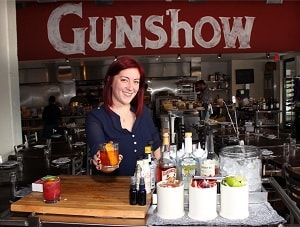 Gunshow’s Mercedes O’Brien
Ask a craft bartender or a chef how they feel about flavored spirits, and the answer is fairly predictable: “If I want a flavored spirit, I’ll do it myself.”
“All the flavors I could possibly want are 100 feet away,” says Chris Gianaras, beverage manager at Atlanta restaurant 4th & Swift, referring to his restaurant’s first-rate kitchen.
Craft cocktail bars tend toward the DIY attitude with most of their ingredients. But the particular bias toward flavored spirits probably stems from the sickening number of flavored vodkas that have flooded the market in recent years. Many vodka flavors are clearly artificial, and clearly marketed to underage drinkers, barely legal drinkers, or at least those with palates that are not accustomed to actually enjoying the flavor of alcohol. Does a grown adult want their drink to taste like caramel whipped cream or tropical gummy candy? Probably not, and the majority of Georgia restaurants are understandably not keen on serving these types of flavored products.
But there are some really well-made flavored vodkas out there – Square One Cucumber and Hangar One Buddha’s Hand come to mind. But the real news in the flavored spirits category for the past few years is flavored whiskey.
Breakout Category
 Whiskey, as a category, saw a 30-year decline of almost 50 percent in sales from 1970 to 2000, according to the Distilled Spirits Council of the United States (DISCUS). But a few things happened starting in 2000 that led to 13 years of accelerated growth. One thing is an explosion in the “super premium” whiskey category, the most expensive whiskeys, like MacAllan 18-year, Noah’s Mill and Pappy Van Winkle.
The other thing that happened is the introduction to the market of flavored whiskeys. In 2012, flavored whiskeys accounted for 75 percent of the growth in the whiskey category, according to Nielsen ratings. In 2013, flavored whiskey made up 45 percent of the growth, according to DISCUS. During that time, Fireball, a cinnamon-flavored whiskey owned by Sazerac, found its way onto the list of Top 10 best-selling spirits, bumping off Cuervo Gold in the process.
Flavored whiskey isn’t brand new. Fireball has been around since the mid-1980s, formerly known as Dr. McGillicuddy’s Fireball Cinnamon Whisky. Sazerac acquired it from Seagram’s in 1989, changed the name in 2007, and started a grass-roots social media campaign the likes of which the industry has never seen. Hello, Top 10.
Wild Turkey’s American Honey has been made at the distillery since the 1970s. It, too, underwent a name and marketing change in 2006. Cue the instant list of honey whiskey imitators from Jack Daniels to Bushmill’s to Dewar’s. And according to The New York Times, “the dam burst” in 2009 with Jim Beam’s introduction of the cherry-flavored Red Stag. Now, whiskey flavors from a multitude of producers tout not only cinnamon, honey and cherry, but also apple, maple and spice.
Legal Limits
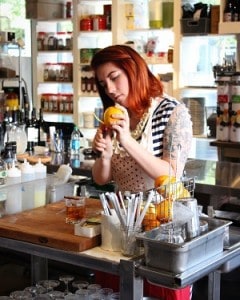 But will whiskey’s more limited range of flavors spare us the gross market saturation that we had with vodka? Vodka is basically a blank slate. Like tofu, it takes on the flavor of whatever you put with it. But whiskey? It’s already got flavors, and only certain things will realistically work. Not to mention, in order to retain the legal right to call something “whiskey,” distillers are held to a higher standard. Regardless of what country it is made in, whiskey must be made from grains, it must be aged in oak barrels and it typically must be bottled at or near a minimum of 40 percent alcohol. This limits what distillers can do to a spirit and still call it whiskey.
This may not make a huge difference to consumers, but it does to bartenders like Mercedes O’Brien, the “Cocktail Cart Conductor” at Gunshow in Atlanta. “To the novice consumer, I don’t think the limits matter much. Certain people want their honeyed whiskey and aren’t necessarily concerned with the codes and ethics portion of the products.” On the other hand, she says that those rules are standards that professionals, like she, can depend on as indicators of overall quality.
Brands like Crown Royal Maple Finish are able to label their product as whisky because they technically follow the rules. According to the Diageo, their “flavoring” comes from finishing their regular Crown Royal whisky in an oak cask with maple toasted onto the wood.
I had a great deal of success using the Crown Royal Maple Finish at King + Duke in Atlanta. A cocktail called the “Root Beer Flip” used the whisky with Art In the Age’s Root liqueur, egg whites, cream and bitters for a cocktail that harkened back to our nation’s early days. (See recipe on page xx.)
Anyone familiar with Scotch should be used to the cask finishing approach. “Aging in a port cask, for example, is widely accepted and even lauded,” says Chris Hall, a partner at Atlanta’s Local Three. However, he feels differently about other types of added flavoring. “Adding honey to Wild Turkey somehow feels like you are changing the intrinsic nature of the spirit. Not sure there’s a big difference in reality, but I do think that they are perceived differently. … Perception is everything.”
To be fair (and legal), Wild Turkey labels its American Honey as a liqueur. According to the company’s website, they just add pure honey to their bourbon. Is adding honey to bourbon before it goes in the bottle really that much different than adding honey to a bourbon cocktail?
I hit a home run at JCT. Kitchen & Bar with a cocktail called the Kentucky 75. Knowing that in our experience at JCT. any cocktail with whiskey sold very well to men, and any cocktail with sparkling wine sold very well to women, I decided to combine the two, and I knocked it out of the park. The blend of American Honey, lemon juice, regular honey syrup and prosecco sold like sweet tea to both genders equally. (And yes, we tried it with regular bourbon, and the cocktail just wasn’t as good.)
The Female Market

In fact, selling whiskey to women is one of the main motivations behind the flavored whiskey boom – and it’s working. Close to 45 percent of flavored whiskey consumers are women, compared to around 30 percent for regular whiskeys. Many in the industry have viewed flavored whiskey as a “gateway” for women and young people into the straight whiskey world.
Eduardo Guzman, current beverage manager of JCT., supports this notion. “Most people who take a shot of flavored whiskey have never taken a whiskey by itself,” he says, adding that shots of American Honey are still very popular with the clientele at JCT.
To further support this idea, I have observed that female friends of mine, who were previously only vodka drinkers, have gradually warmed up to Jack Daniels Honey as a new spirit of choice. This style of drinking may not be what many in the restaurant industry want to cater to, but it’s definitely the way that a large portion of the public drinks.
For many bar managers, to use or not to use flavored spirits comes down to quality. “Does it fit the concept? Is there a clientele for it?” says Guzman. “Craftsmanship and the history behind it play a big role in the decision-making process for buying flavored spirits.”
“Quality is a big factor,” says Garron Gore, general manager and beverage director for Buckhead’s soon-to-open The Gypsy Kitchen and The Southern Gentleman. “There are too many synthetic and fake-tasting flavors on the market. [But] there are some great small producers starting to make high-quality stuff.”
O’Brien of Gunshow agrees. “If something was produced with skill and craft, then I will enjoy working with it. I base all decisions for the bar program on quality,” she says, adding that she still prefers to infuse her own spirits but makes exceptions. “When looking for a flavored spirit, I am most interested in the distillation process, the method of extraction or macerating of flavors, the mouth feel.”
Like O’Brien, Hall prefers to infuse spirits on his own. “We prefer to make things when we can. It’s really about authenticity. The story behind something you bought is generally much less compelling than something you made,” he says.
While many flavored spirits have worked for me at various bar programs I have created, and they continue to work for Guzman at JCT. and the Optimist, they clearly aren’t for everyone in the Georgia restaurant community.
Gianaras stands firm by his belief that “true whiskey lovers want their whiskey to taste like whiskey.” He chooses not to sell any flavored whiskeys at 4th & Swift.
I don’t blame him at all. Despite my success with Crown Maple and American Honey, and despite its obvious popularity, I never could bring myself to carry Fireball.
“I can tell you I never want to hear about Fireball again,” Gore says. “The day I quit is the day I see Jalapeño whiskey!”
Lara Creasy is a consultant with more than 14 years experience in beverage management. She has developed wine and cocktail programs for such restaurants as St. Cecilia and King + Duke through her consulting business Four 28, LLC. Her work has been featured in such publications as Bon Appetit, Imbibe, and Wine Enthusiast.



