By Nancy Wood
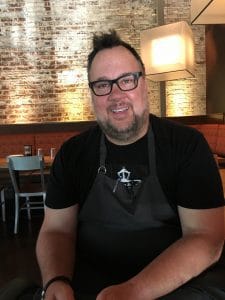 Scott Serpas
A Louisiana native, Scott Serpas has been cooking up good food almost his whole life. Part of a large family, he found he liked spending time in the kitchen growing up – then later found he liked working in a restaurant even more.
Serpas opened his own Atlanta restaurant, Serpas True Food, in 2009. That same year, the restaurant was named one of the 10 “Best New Restaurants in America” by GQ Magazine.
Located in Studioplex in the Old Fourth Ward neighborhood, Serpas True Food is on the Atlanta BeltLine, the internationally renown and award-winning greenspace initiative that is bringing new restaurants, retail and housing along a 22-mile ring encircling the city.
Today Serpas and his family call Atlanta home, and he’s always looking for ways to make his community even better. He donates his time and effort to organizations like Share Our Strength, the American Liver Foundation, Camp Twin Lakes and the March of Dimes.
Restaurant Informer talked with Serpas about how he’s seen the area around his restaurant change, what today’s diners are looking for in a restaurant and why it’s important to give back. Following are edited highlights from the conversation.
RI: How did you first become a part of the restaurant industry, and what was your first job?
SS: I was born and raised in New Orleans, and my mom and dad loved to cook. I’m the youngest of five kids, and I was always in the kitchen. We had craw sh boils and shrimp boils – I had a big family, and we always got together and did something in the kitchen. I was really attracted to cooking in that sense, and my mom was a good cook.
As I got older, I got jobs in restaurants as a busboy and running food, but I was really interested in the kitchen and what they did. So I applied to culinary school at Delgado’s, a small community college in New Orleans. They had a culinary arts program in which you went for three years, which is a little bit different from some of the other ones.
As soon as you signed up, you had to find a job. If you didn’t find a job in a restaurant, they would find you a job – which was good because right away, you knew whether it was for you or not. You didn’t have to go through a year-and-a-half or two years of doing externships.
I was 19 when I started out in the restaurant business. I was very attracted to it – working in the French Quarter at Mr. B’s Bistro, the Le Meridien Hotel and Mike’s on the Avenue. That’s how I got my feet wet. I really liked it a lot – creating, learning the inner workings of a kitchen and a restaurant. Working for the Brennans [the family owns 13 restaurants in New Orleans, including Mr. B’s Bistro] taught me a lot about that.
RI: How long have you been in Georgia and what first brought you here?
SS: I moved to Dallas, Texas, in 1990 and worked for Kevin Rathbun from 1990 to 1994. Then he got an opportunity to open Nava in Buckhead, so I moved with him from Dallas and worked there for a few years. I went home in ’94 for a year-and-a- half and came back to open up a place called Sia’s in North Fulton in 1998. So I’ve been here permanently since 1998.
RI: What do you like best about the state?
SS: I love the people and love the community sense and the history here – the topography, the landscape, the trees, the hills. There’re a lot of things that are good about Atlanta. It’s a growing city, and its proximity to Louisiana is pretty close, too, so that’s not too bad.
RI: Where’s your favorite place to eat in Georgia?
SS: I eat out more and search out more restaurants when I go out of town than I do in Atlanta. I just have more time. When you go somewhere, you have more free time to do something like that. There’re a lot of little local spots that are fun.
To be honest, when I’m away from the kitchen, I’m easy. I like chicken wings, pizza, burgers – a lot of that stuff is in the bloodlines of a lot of chefs. They don’t want anything ‘foo-foo,’ they want down and dirty, like barbeque – not foam and pretty dishes and that style of cuisine.
You always learn something when you go to a restaurant – whether it’s something in the bathroom that’s cool like the way it’s designed or the way they execute the kitchen. I try to ask the chef if I can take a walk-through. You always get ideas about how they execute things and how things have changed with the millennials now –how to adapt to what they do now and how to be more relevant than the old-school style. I’m always learning.
RI: Have you changed anything about your restaurant to accommodate the millennials?
SS: They like a lot of small plates and a lot of grab and go. I don’t have grab and go right now, but it’s something I need to think about in the near future because of our close proximity to the BeltLine. There are quite a bit of appetizers on the menu that you can share and things that are a little bit more affordable.
RI: You opened Serpas True Food well before this portion of the Atlanta BeltLine was completed. What was behind your decision to open your restaurant where you did?
SS: There were a couple of spots – this was back in ’08. There was a spot on the Westside I looked at that was almost across the street from where Bocado is – it didn’t work out for some reason. My agent found the space on the BeltLine in Studioplex.
When I worked at Two Urban Licks – when we opened that up – they told us a little bit about the BeltLine, and I saw the vision of what they were doing. I liked what I heard about what was coming up in the future. This space was right on the BeltLine – a really cool-looking space with high ceilings. I really liked the space, the proximity and the parking was really good – and just a good vibe. I had a good feeling about it.
RI: Was there anything different about building out a restaurant in a historic structure vs. building new?
SS: This was my first restaurant that I built on my own. There’s a learning curve. There’re a lot of things you have to go through and think about – a lot of things to do with the city, a lot of rules and regulations. They make you jump through all these hoops, and you learn a lot when you’re going through it – more than I wanted to learn (laughs). You see what other restauranteurs have to go through to make it happen.
People think the restaurant business is very glorified, but it’s not that much fame and fortune, I tell you. It’s definitely a labor of love. I’m very passionate about what I do. The food aspect, the people aspect of it – trying to grow this new generation and try to teach them a work ethic – that’s a great part of it that I really enjoy.
RI: Now that the BeltLine is running behind your restaurant and there’s so much more development around you, how has that changed things?
SS: I was locked in for rent, so that was a good thing. We started in ’08 and opened in ’09, and the economy wasn’t that great at all. It’s grown a lot, but there’s a lot more competition as well. There’re a lot more restaurants just in a 1⁄4-mile radius. There’re a good 20 to 25 restaurants in walking distance, with Krog Market, North Highland, Ponce City Market, and there’re a lot of different, smaller, individual restaurants as well.
I always tell my staff – there’s a lot more competition out there, so we have to be on our A game. Because when those doors open at 5:30, you’ve got to be ready – or at 11 for Sunday brunch – it’s go time.
It’s not just about the food, it’s about taking care of the guests and knowing the menu and giving them that all-around quality experience to where they want to come back to Serpas, and they want to tell their friends about Serpas. It’s a good challenge to have. It’s attracted more people from the BeltLine since it’s more walkable, and different events going on throughout the year really attract people and bring them in. It’s a win-win situation.
RI: Was there a specific decision not to open for lunch?
SS: At the time, there wasn’t a lot of business traffic around there. I’d thought about it at one point, but it really wasn’t there. Now, it could possibly be there. There’s more construction going on on the BeltLine right behind us. They’re putting up retail as well as more townhomes and more commercial, so it’s something I may think about in the future.
I’m open for dinner Tuesdays through Sundays and Sunday brunch. The next step would be to try and open for Saturday brunch. I think Saturday brunch would be a good draw. I just have to work out the staffing situation. I think that’s something that could be coming up in the near future.
RI: Who is the most influential person to you in the restaurant industry?
SS: As far as work ethic and being humble, I think I’d have to say my mom and dad – even though they weren’t in the industry. They taught me a lot about work ethic and doing the right thing. I think I’ve learned a lot about myself and just being true to yourself.
RI: What’s the best thing about being a chef and restaurateur?
SS: The fact that you wear a lot of different hats. It’s not only managing and teaching – being a mentor. It’s also giving people advice through life, whether it’s financial advice or personal advice. It’s being able to connect with people and try to help people out. People have helped me out along my career in different ways.
RI: What do you see as some of the biggest challenges for the restaurant industry right now?
SS: Understanding the millennials and a new generation. It’s a little bit different. I think they like a lot more fun food, portable food items and a smaller footprint – not a big restaurant like mine – and maybe a couple of locations. I think they’re very adventurous as far as food goes. I don’t think they’re scared about food like other generations have been. I think you can be a little more creative and a little more outside the box.
RI: What are some of the trends you are seeing right now in the restaurant world?
SS: I don’t think people want fine dining – that sit-down, formal hour-and-a-half, two-hour dinner. I think they want more relaxed, fast-casual, crafty cocktails, fun food – combining all in one – a place to go, hang out, drink.
Back when I was growing up you wouldn’t really go out to eat. You’d grab something to go and then you’d go out to a club. Clubs have kind of gone away. These places have all in one – a gaming event or a pop-up, food vending thing. A lot has changed.
RI: Are you using more technology?
SS: We’re using OpenTable, and there’s a lot of things you can do on your phone now. You can look on your phone for reservations, you can change your thermostat and turn off your alarm in your restaurant, you can look at inventory, time management, labor costs, food costs, liquor and wine costs – all those things are at your fingertips. It’s a lot more user-friendly these days and a lot easier.
RI: How do you feel about people taking pictures of your food and posting online?
SS: Yeah (laughing) – and some of them aren’t the best shots either. There’s nothing you can do about it. You put out the best product you can. The younger generation, especially the staff in the kitchen, they know that a lot of pictures will be taken and posted on Facebook and Twitter. You get your name out there, and people will be talking about it. There are some [reviews] out there that you kind of battle with a little, but you try to think back about the instance and what they might have had a problem with. But for the most part, we’ve had some great reviews and great support and great local followings, so I’m very fortunate.
I can only thank my staff for that. I’m not always there, and they’re an extension of me. You try to do the right thing and show them the right thing. Hopefully, they’ll follow in your footsteps.
RI: What do you cook for yourself when you’re not in the restaurant kitchen?
SS: I enjoy cooking on my Green Egg. If I’m off one day, I’ll try to get a pork shoulder or a good steak or a piece of fish. I try to do as much cooking on that Green Egg as possible so I don’t heat up the kitchen at the house. It’s fun, but I don’t do it much as I used to.
I try to get adventurous. I have a six- year-old daughter, and she’s becoming more adventurous as far as food. I’m trying to teach her a little more about that as well – which is fun.
RI: If you could create your last meal, what would it be?
SS: I think my last meal would be boiled crawfish. I gotta be true to where my roots are … gumbo, jambalaya – all Louisiana.
RI: What are you currently reading?
SS: Franklin’s Barbecue: A Meat Smoking Manifesto – it’s about Franklin’s out of Austin, Texas.
RI: A lot of stars making movies in Atlanta come to your restaurant. Have you ever been star-struck?
SS: It would have to be Robert Downey Jr. – he’s been in a lot for brunch. He’s very laid back, not at all pretentious – all in all, a good guy.
RI: You spend a lot of time volunteering in the community. Can you talk about your penchant for giving back?
SS: I think it’s important to give back to the community. Growing up in New Orleans, it’s a big community thing. There’s a big sense of neighborhood and family. It’s important to give back, because one day you might be on the other side of the fence and need help. It’s good to be helpful.



