
The restaurant industry is notorious for slim profit margins. One idea for increasing revenue is by selling branded merchandise. These days it’s hard to find a restaurant or bar that isn’t selling something besides food and drinks, but does it make sense for every owner/operator?
Consider the benefits. Merchandise not only provides brand exposure—it can be a low-cost way to increase name recognition, solidify a connection to your customer base or community and introduce your brand to new customers. It can even become a fundraising mechanism – especially during the holidays.
Deciding what might work for your venue takes some planning. First, consider the investment you’re comfortable making. Next, decide what items might appeal to your customers. You’ll also need to manage design, production and inventory. And don’t forget about promoting and selling the items.
 Making the Most of Your Story
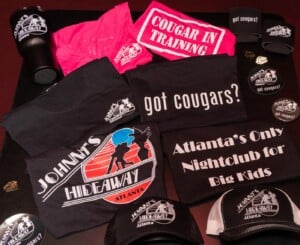
At Atlanta’s iconic nightclub, Johnny’s Hideaway, T-shirts featuring their logo, as well as some touting their reputation as a hangout for ‘cougars’, have been a mainstay since 1990. “Everything else,” says owner Chris D’Auria, “has trickled in over the years.” That includes hoodies, tumblers, hats, lapel pins, koozies, and stickers – even branded water.
Although many restaurants and bars use professional designers to develop their promotional items, at Johnny’s Hideaway, the ideas start at home. “Various staff members usually come up with the ideas,” he explains, “then I tinker with it and order a small amount.” D’Auria doesn’t make a big investment in new merchandise initially and says, “If it moves, we keep it. If not, we store it. The misses far outnumber the hits.” One of his surprise hits? The tumblers. “I never thought the tumblers would move and they have done well.” While he doesn’t view selling merchandise as a strong revenue stream, D’Auria says there is a serious margin on the branded water.
Like many places that sell promotional merchandise, branding and connecting with customers outweighs the profit margin. Says D’Auria, “Selling Johnny’s Hideaway merchandise keeps the brand top-of-mind as new and loyal guests proudly show off their swag, reliving memories and sharing the experience wherever they go.”
 Go Big or Stay Home
Like many restaurateurs, Chris Smith, CEO of Zunzi’s and Zunzibar, doesn’t consider promotional merchandise a revenue stream. It’s his way of creating a fan base – just like a sports team. “I don’t believe in loyalty for the sake of loyalty,” he says. “I believe in building fan relationships.” Over the years, he’s done just that.
Zunzi’s, which opened in 2005, “has always been a brand that people really loved,” says Smith. Since the beginning, they created and sold T-shirts, but that model has evolved over the years. In 2018, the company began offering branded merchandise and added their signature sauces in 2021. That evolution now features an expansive array of merchandise on the Sh!t Yeah shopping site, which is set up on Shopify, the e-commerce platform.
“Shopify allows you to integrate with POS systems like Pretzel, and Printful is our partner for all of the materials,” explains Smith. “Our in-house designer can create whatever he wants and they fulfill it for us in two days and drop ship it as a one-off, so there’s no cost to us to carry inventory.” The ideas for merchandise come from both employees and fans and now includes everything from polo shirts, hats and backpacks to beach towels, swim trunks and throw pillows – even pet leashes and collars.
Smith also created the 26 Club, a two-way texting app for fans and employees. “They can text us ideas, and it allows us to keep building what the customer wants and basically turn them into raving fans.” Smith also promotes the merchandise and signature sauces by giving away $26 gift cards fans can use on the shopping site. “If you give your best fans a $26 gift card or 26 percent off and they buy a shirt, now they’re advertising for you.”
Making the ROI Mean More
Although many organizations may not consider selling branded merchandise and signature foods as a revenue stream, for Meals on Wheels Atlanta (MOWA), profit is the driving force behind their Purposeful Gourmet Foods. The nonprofit devised the promotion in 2018 to help generate additional funds to support their mission of providing meals to seniors, when other fundraising wasn’t meeting their needs.
After connecting with the former executive chef of the Four Seasons Hotel Atlanta, Robert Gerstenacker, who joined the team as culinary director, the idea for Purposeful Gourmet Foods took shape. “The idea of doing a gourmet packaged food product that was made in-house with Georgia pecans came from Robert and is based on bar snacks – one savory and one sweet – he served at the Four Seasons,” says Jason Tucker, Chief Innovation and Business Development Director.
This year, MOWA is changing their strategy to focus on fourth quarter fundraising goals when the nonprofit gets most of its financial support. “We know what we need for each quarter,” he explains, “so all of our purchasing is centered around the holiday program. We look at the profit margins and produce the pecans based on what we intend to sell. And Chef Robert makes the pecans with those goals in mind.”
To make the gift boxes even more enticing, MOWA also offers co-branded items with Georgia-based partners called Purposeful Fruits, which includes jam, toffee and honey. “It’s a great networking opportunity to consider other local products that we can include to make it special,” adds Tucker.
While corporations are MOWA’s top customer for the gourmet gift boxes, the organization is constantly engaging with the community and their volunteers by leveraging every marketing tool they can to increase sales. In addition to social media and word-of-mouth, Tucker says, “We have a unique opportunity to bring volunteers into our building to help pack meals and help with our pantry. So every time a volunteer group comes, we display those boxes.”
While MOWA doesn’t calculate the gift box sales as a separate revenue stream, they do measure in terms of how many meals each one provides. “There are so many gift companies,” he says, “but this is a special way to support Meals on Wheels and help us fulfill our mission.”



